

Mon - Sat 9:00 - 17:30
As fire safety professionals, we're trained to see risks others might overlook. Unfortunately, we can't always "switch off" that sense, even when visiting a colleague.
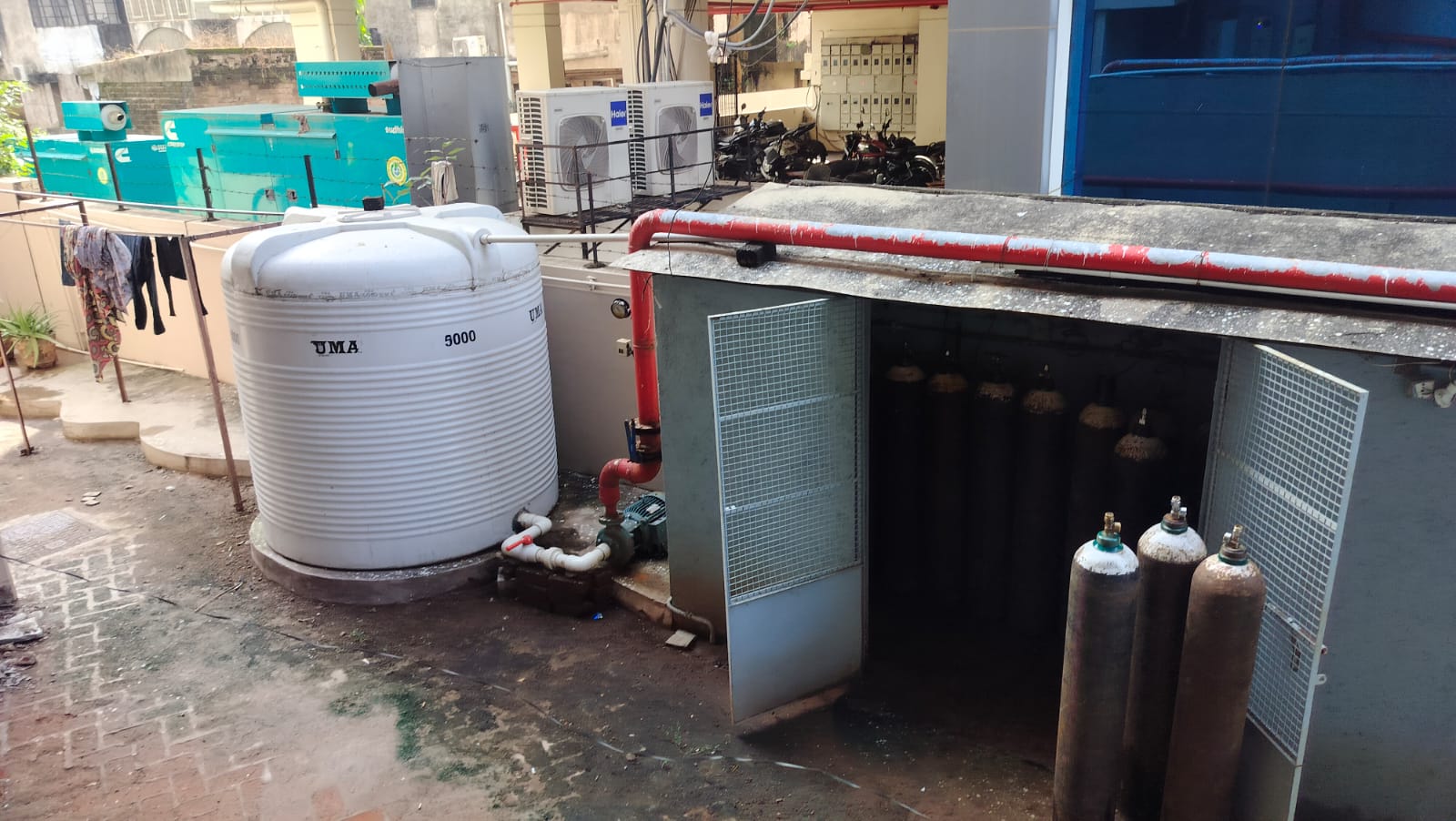
I was at a hospital recently and what I saw in their utility area was deeply alarming. The attached photo shows a ticking time bomb: a bulk oxygen cylinder storage room located directly adjacent to the facility's main fire pump and a plastic (combustible) fire water tank.
This arrangement creates a catastrophic failure loop:
Oxidizer: Oxygen (a powerful oxidizer) is stored in bulk.
Ignition Source: It's placed inches away from an electric pump (an ignition source) and other electrical/mechanical equipment.
Fuel: The storage is next to a large plastic water tank, which is itself a significant fuel source.
If a fire starts here—from a pump short circuit or electrical fault—it will be fed by the oxygen, turning a small fire into an inferno. This fire would immediately destroy the only fire pump and the entire water reserve, leaving a hospital full of non-ambulatory patients with no active fire protection.
This isn't just poor design; it's a direct violation of established safety codes.
For my fellow professionals and facility managers, here's a breakdown of the critical issues based on the National Building Code of India 2016 (Part 4: Fire and Life Safety):
1. Oxygen Storage Location (The Most Critical Hazard)
Hazard: Storing a high-risk oxidizer (oxygen) next to ignition sources (pumps, generators) and combustible materials (the plastic tank) is a textbook recipe for disaster.
NBC Clause: Section 4.10.2.1 (Location of Gas Cylinder Storage) is explicit. It mandates that storerooms for flammable and oxidizing gases "shall be separated from each other and from other parts of the building by fire-resistant construction of at least 2 hours."
Separation Distance: While NBC provides the fire-rating, best practices and the Gas Cylinders Rules, 2016 (under PESO) mandate separation. A minimum distance of 6 meters (approx. 20 feet) is typically required between oxidizing gas storage and any combustible materials, ignition sources, or building openings. This setup has 0 meters.
2. Lack of Fire Pump Redundancy
Hazard: The facility relies on a single, electrically-operated fire pump. If power fails in a fire (which is common), the entire firefighting water system is useless.
NBC Clause: Section 6.4.2.1 (Arrangement of Pumps) requires redundancy. For a hospital, this almost always means a system with at least two independent pumps (e.g., one electric and one diesel-driven) to ensure water can be supplied even during a power outage.
3. Insufficient Fire Water Storage
Hazard: The "UMA 9000" tank (likely 9,000 liters) seen in the photo is grossly insufficient for a hospital.
NBC Clause: Annex E (Tables E-1 to E-4) details the minimum water storage requirements based on building type (Institutional) and height. Even a small hospital would require 50,000L to 100,000L or more, not 9,000L.
Regarding the storage room itself: "blast-proof" isn't the precise term, but the requirement is for a robust, dedicated, and safe enclosure.
The Gas Cylinders Rules and NBC 4.10 require that such storage be a room of non-combustible construction with adequate ventilation (to prevent oxygen enrichment). Often, these rooms are required to have blast-relieving features (like a lightweight, frangible roof) to ensure that in the event of an overpressure, the force is directed upwards and safely, rather than destroying the building.
The flimsy shed with mesh doors seen in the photo is dangerously non-compliant.
This is a stark reminder that fire codes are not just bureaucratic hurdles; they are life-saving standards written from past tragedies. For a hospital, where occupants are at their most vulnerable, there is no excuse for cutting corners on fire safety.
I urge all facility managers, especially in healthcare, to review your utility and storage areas today. Are your oxidizers, fuels, and ignition sources properly separated? Is your fire protection system truly redundant and compliant?
#FireSafety #HospitalSafety #NBC2016 #RiskManagement #Compliance #Engineering #OxygenSafety #FireProtection #SafetyFirst

We offer a full suite of HSEFS services designed to address your specific challenges and goals :
HSE Consulting & Advisory,
HSE Auditing & Assurance,
HSE Training & Development,
Implementation & Support,
Environmental Services
GST: 24ABDCA0826H1Z3
CIN: U71100GJ2025PTC163795
Copyright 2025. Agni Raksha Niti Engineering Consultancy Services Pvt. Ltd. All Rights Reserved.