
Mon - Sat 9:00 - 17:30

Weekly Update : Fire incident (26 Nov. to 03 Dec. 2025)

The Indian Fire Safety Crisis: A Forensic Analysis of Incidents (November 26 – December 3, 2025)

1. Executive Summary

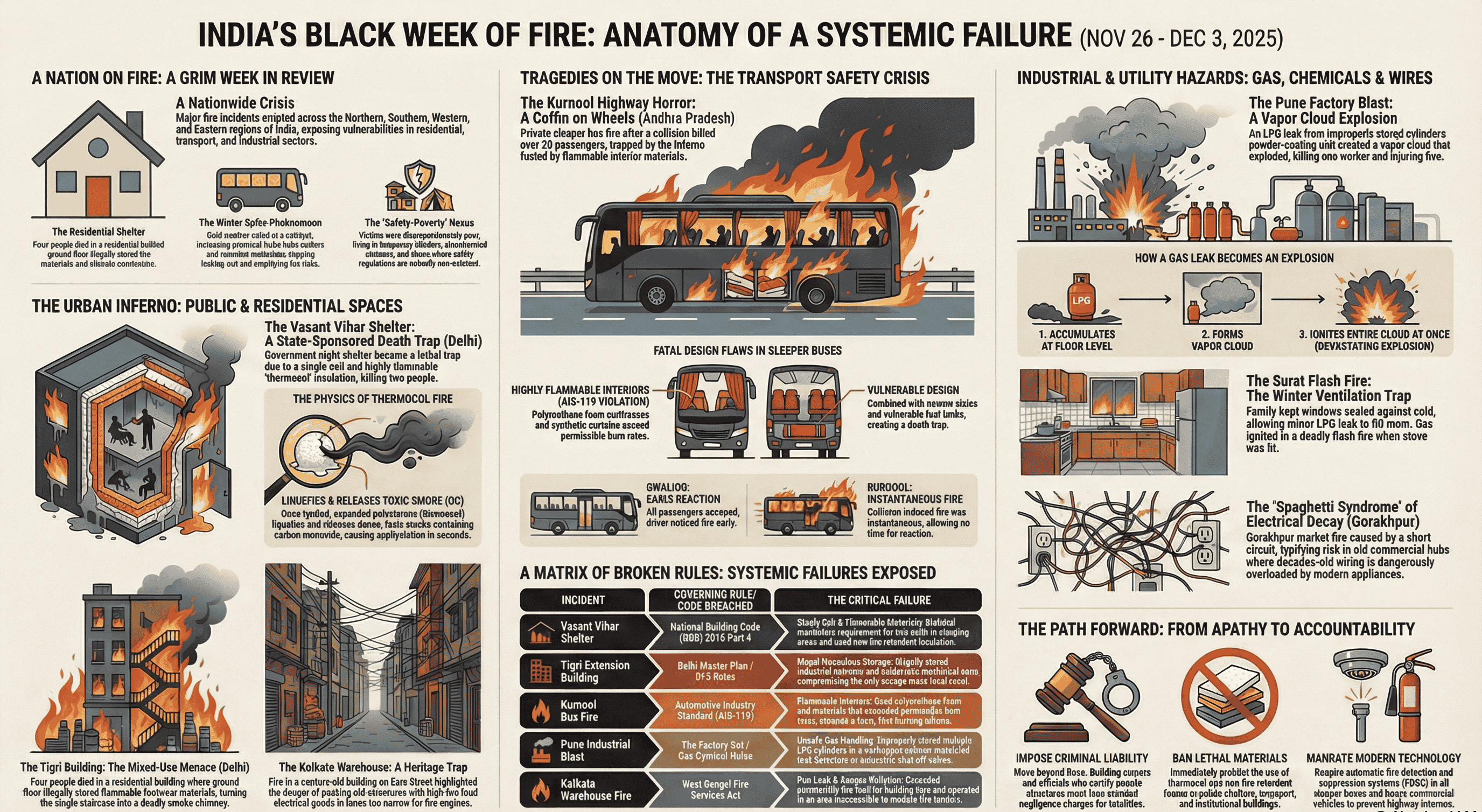
The week commencing November 26, 2025, and concluding on December 3, 2025, has emerged as a period of profound distress and systemic revelation for India's public safety infrastructure. Across the subcontinent, a relentless sequence of fire-related disasters has exposed the fragility of the nation's urban planning, the lethality of its transportation networks, and the perilous condition of its industrial and domestic spaces. From the chilling asphyxiation of homeless citizens in New Delhi’s government-sanctioned shelters to the horrific incineration of passengers on a highway in Andhra Pradesh, the events of this week serve as a grim tableau of negligence and regulatory failure.

This comprehensive report provides an exhaustive, expert-level reconstruction of these incidents. It does not merely catalogue the tragedies but dissects them through the lenses of forensic fire dynamics, urban sociology, and legal compliance. The analysis reveals a disturbing convergence of factors: the seasonal vulnerability induced by winter heating demands, the brazen violation of land-use laws in the National Capital Region, the obsolescence of safety protocols in the interstate transport sector, and the persistent "audit gaps" in industrial zones.

The cumulative toll of these incidents—spanning the geographies of the North (Delhi, Uttar Pradesh), South (Andhra Pradesh, Karnataka, Kerala), West (Maharashtra, Gujarat), and East (West Bengal, Assam)—exceeds dozens of fatalities and injuries, with significant economic loss. More critically, these events underscore a crisis of governance where the National Building Code (NBC) 2016 and various state fire acts exist as theoretical documents, largely divorced from the ground reality of enforcement.

The following sections will rigorously examine each incident, providing a minute-by-minute reconstruction where possible, analyzing the "physics of the failure," and mapping the specific regulatory breaches that transformed preventable hazards into fatal catastrophes.


2. The Northern Inferno: Systemic Rot in the National Capital Region & Uttar Pradesh

The National Capital Region (NCR), particularly Delhi, witnessed a concentration of fire incidents that highlighted the stark inequality of safety. The fires here were not random acts of God but the deterministic results of policy failures regarding housing for the poor and the regulation of mixed-use neighborhoods.

2.1. The Vasant Vihar Night Shelter Tragedy: A State-Sponsored Death Trap

2.1.1. Incident Reconstruction and Fire Dynamics

In the pre-dawn darkness of Monday, December 1, 2025, a devastating fire erupted at a "Rain Basera" (night shelter) in the Coolie Camp area near Vasant Vihar, Southwest Delhi.1 The facility, managed by the Delhi Urban Shelter Improvement Board (DUSIB) and operated by the Society for the Promotion of Youth and Masses (SPYM), was intended to protect the city's most vulnerable from the winter chill. Instead, it became a lethal confinement.

The fire was reported at 3:15 AM 1, a time correlating with the deepest phase of sleep for the occupants, significantly delaying reaction time. The structure itself was a temporary "porta-cabin" type, constructed using materials that prioritized cost and insulation over fire resistance. Forensic indicators suggest the core material was tin sheeting lined with expanded polystyrene (thermocol) and foam insulation.2

The Physics of the Fire:

Thermocol, a petroleum-derived product, possesses a terrifyingly high heat release rate (HRR). Once ignited—likely by a short circuit or an unattended heating device in the kitchen area 1—the material does not merely burn; it liquefies and vaporizes. The combustion of polystyrene releases dense, acrid black smoke containing styrene monomers, carbon monoxide, and other asphyxiants. In a confined space like a night shelter, this creates a "toxic atmosphere" within seconds, long before the structural temperature reaches lethal levels for skin burns.

The fire spread vector was rapid, moving from the kitchen towards the single entry point. The "chimney effect" within the enclosed cabin caused the hot gases to stratify and then descend, enveloping the sleeping quarters.

2.1.2. The Human Toll and Sociological Context

Two individuals paid the ultimate price for this systemic oversight: Arjun (19), a sanitation worker from Sambhal, Uttar Pradesh, and Vikas (42).3 Their deaths were likely caused by smoke inhalation and asphyxiation rather than thermal trauma initially. Arjun, described as a hardworking youth who had recently purchased a smartphone—a symbol of his aspirations—reportedly returned to the burning structure in a desperate attempt to retrieve his possession, a tragic testament to the value of assets for the working poor.5

Five other inmates managed to escape, but the psychological trauma of witnessing their fellow residents perish in a "boxed-in" trap remains immeasurable. The incident highlights the precarious existence of India's urban homeless, for whom the state's protection (shelters) is often as hazardous as the elements they seek to escape.

2.1.3. Structural Analysis: The "One-Exit" Violation

The primary systematic failure in Vasant Vihar was the layout of the shelter. Survivors explicitly stated that the shelter was a "boxed-in tin shed" with no rear exit.2

  • Regulatory Breach: This is a flagrant violation of the National Building Code (NBC) 2016, Part 4 (Fire and Life Safety), which mandates that any structure used for sleeping accommodation (Group A - Residential) must have at least two distinct means of egress to prevent occupants from being trapped if one exit is blocked by fire.
  • Operational Negligence: The NGO claimed to have refilled fire extinguishers and conducted training.1 However, the efficacy of a handheld extinguisher is negligible against a rapid-onset hydrocarbon fire (thermocol/foam) in a structure with no passive fire protection or sprinkler systems. The melting of locks due to intense heat further compounded the entrapment.1

2.1.4. The Winter Safety Paradox

Delhi’s Home and Urban Development Minister, Ashish Sood, acknowledged the danger of angithis (coal braziers) and biomass burning inside shelters.6 The "winter effect" creates a paradox: to survive the cold, inmates seal the shelters (reducing ventilation) and introduce heat sources (increasing ignition risk). Without safe, central heating systems provided by the state, this cycle of risk is perpetuated annually.

2.2. The Tigri Extension Blaze: The Mixed-Use Menace

2.2.1. Incident Overview

On the evening of Saturday, November 29, 2025, a catastrophic fire engulfed a four-storey building in Tigri Extension (Sangam Vihar), South Delhi.7 The fire claimed four lives, including the building owner Satender (38) and his sister Anita (40).7

2.2.2. Root Cause: Hazardous Storage in Residential Zones

The fire originated in a footwear shop located on the ground floor.7 Footwear manufacturing and storage involve high-fire-load materials:

  • Rubber and Synthetic Leather: These materials burn with high intensity and produce thick, oily smoke.
  • Adhesives (Solvents): Shoe making often uses solvent-based glues (like Dendrite), which are highly volatile and flammable.

Systemic Failure: The existence of such a "High Hazard" occupancy within a residential building is a failure of Delhi's Mixed Land Use policy. While the policy allows for certain commercial activities, it explicitly prohibits hazardous trades.9 The storage of bulk flammable rubber and solvents falls under hazardous categories that should never be permitted below residential apartments.

2.2.3. The Staircase as a Chimney

In narrow plots typical of unauthorized colonies like Sangam Vihar, the staircase is often the sole vertical shaft. When the fire erupted on the ground floor, the staircase acted as a chimney, funneling toxic smoke and superheated gases to the upper floors. This effectively cut off the escape route for the residents above, trapping them in their homes. The death of the victims was likely due to this entrapment, forcing them to face the inferno with no egress.

2.3. The Gorakhpur Market Fire: Electrical Decay

2.3.1. Incident Details

On December 1, 2025, a massive fire broke out in "Baby Land," a garment shop in the congested Golghar market of Gorakhpur, Uttar Pradesh.11 While no casualties were reported, the blaze gutted the establishment and caused widespread panic.

2.3.2. Technical Analysis

The cause was identified as a short circuit.13 This incident exemplifies the "Infrastructure Deficit" in India's older commercial hubs.

  • Load Mismatch: As shops modernize with air conditioning, bright lighting, and digital signage, the electrical load increases exponentially. However, the underlying wiring infrastructure often remains decades old, with degraded insulation and insufficient ampere capacity.
  • The "Spaghetti" Syndrome: The chaotic entanglement of overhead cables in markets like Golghar prevents effective maintenance and increases the risk of arcing.
  • Fuel Load: Garment shops are Class A fire risks (solid combustibles). The tight packing of synthetic fabrics allows for rapid flame spread, turning a small spark into a fully developed fire within minutes.


3. The Southern Tragedies: Transport & Institutional Failures

The southern states, often lauded for better governance, were not spared. The incidents in Andhra Pradesh, Karnataka, and Kerala revealed gaps in transport safety codes and institutional crisis management.

3.1. The Kurnool Highway Horror: A Coffin on Wheels

3.1.1. Incident Reconstruction

In the dark hours between November 29 and 30, 2025, a private Volvo sleeper bus operated by Kaveri Travels, traveling from Hyderabad to Bengaluru, collided with a motorcycle near Chinna Tekuru village in Kurnool district, Andhra Pradesh.14

The Sequence of Disaster:

  1. Collision: The bus struck a two-wheeler. The impact was likely severe enough to rupture the fuel tank of the motorcycle or damage the bus's own fuel lines.
  2. Ignition: Sparks from the friction of the crash ignited the leaking fuel.
  3. Propagation: The fire spread instantaneously to the bus chassis.
  4. The Inferno: Within minutes, the entire vehicle was engulfed.

The toll was horrific: estimates suggest between 7 and 20+ fatalities, with bodies charred beyond recognition.14

3.1.2. The Failure of AIS-119 and Bus Body Codes

This tragedy brings into sharp focus the failure of the Automotive Industry Standards (AIS), specifically AIS-119 (Sleeper Coach Building Code).

  • Flammability of Materials: Sleeper buses are heavily furnished with polyurethane foam mattresses, synthetic curtains, and carpets to provide comfort and noise isolation. These materials are highly flammable. When they burn, they release hydrogen cyanide and carbon monoxide. In a sealed, air-conditioned cabin, these gases incapacitate passengers before they can wake up and react.
  • Fuel Tank Placement: The vulnerability of the fuel tank to a frontal or side collision suggests a design flaw or an illegal modification to increase fuel capacity (a common practice among private operators to avoid frequent refueling).
  • Egress Issues: Sleeper buses have narrow aisles (often less than 450mm). In a panic scenario, passengers trying to exit from upper berths fall into the aisle, creating a blockage. The emergency exits (break-glass windows) are often difficult to operate amidst thick smoke and panic.

3.2. The Bengaluru Lodge Mystery: Suicide or Accident?

3.2.1. Incident Overview

On the evening of November 27 (reported Dec 1), a tragic incident occurred at the Coolie Comfort Lodge in Yelahanka New Town, Bengaluru.16 A young couple, Kaveri Badiger (25) and Ramesha Bandivaddar (22), were found dead.

3.2.2. Fire Dynamics and Forensic Evidence

Unlike the structural fires in Delhi, this was a localized, likely intentional fire.

  • Accelerant Use: Police suspect Ramesha used petrol to set the room ablaze.16 Petrol is a liquid accelerant that causes a flash fire with extreme heat release.
  • Asphyxiation vs. Burns: Kaveri was found near the bathroom door with no burns but died of suffocation.16 This confirms the rapid production of toxic smoke in a confined hotel room, likely from the burning of bedding and furniture accelerated by petrol. Ramesha died of burns.
  • Hotel Safety: The incident raises questions about the lodge's fire detection systems. Did the smoke detectors trigger an alarm? Did the staff have master keys to access the room immediately? The delay in rescue suggests a failure in the emergency response protocol of the hospitality establishment.

3.3. The Kozhikode Hospital Near-Miss: A Lesson in Defend-in-Place

3.3.1. Incident Overview

On November 29, 2025, a fire broke out on the ninth floor of the Baby Memorial Hospital in Kozhikode, Kerala.17 The fire originated in the AC plant room due to a short circuit.

3.3.2. Institutional Resilience

Hospitals present a unique challenge known as "Defend-in-Place." Unlike other buildings, total evacuation is often impossible due to the presence of critical patients (ICU, ventilators).

  • Success: The fire was contained without casualties. This suggests that the hospital's compartmentation (fire doors separating the plant room from patient wards) was effective.
  • Failure: The occurrence of a short circuit in a critical utility area (AC plant) points to a lapse in preventive maintenance. NBC 2016 Part 4 mandates rigorous maintenance schedules for electrical systems in institutional buildings. The fact that the fire occurred suggests these schedules may have been compromised.


4. The Western Front: Industrial Explosions & Domestic Gas Leaks

The industrial corridors of Maharashtra and the residential zones of Gujarat witnessed fires driven by chemical processes and gas dynamics.

4.1. The Pune Industrial Blast: The Vapor Cloud Explosion

4.1.1. Bhosari MIDC Incident

On December 1, 2025, a powder-coating unit in the Bhosari MIDC (Maharashtra Industrial Development Corporation) area of Pune was rocked by a massive explosion.18 The blast killed one worker, Sunil Kumar, and injured five others.

4.1.2. Root Cause Analysis

The incident was triggered by an LPG leak.18

  • Mechanism: Powder coating requires curing ovens, often fueled by LPG. A leak in the manifold or piping allowed LPG (which is heavier than air) to accumulate at the floor level.
  • Vapor Cloud Explosion (VCE): In a confined factory shed, this accumulated gas formed a vapor cloud. When it encountered an ignition source (a spark or pilot light), it didn't just burn; it exploded.
  • Regulatory Failure: The Factory Act and the Static and Mobile Pressure Vessels (Unfired) Rules mandate gas leak detection systems and automatic shut-off valves for such installations. The scale of the blast suggests these safety layers were either absent or non-functional. The presence of "multiple cylinders" 18 inside the working area is also a violation of storage norms.

4.2. The Surat Flash Fire: The Winter Ventilation Trap

4.2.1. Incident Overview

On December 2, 2025, a flash fire in a residential room in Surat, Gujarat, killed one person and injured three others.19

4.2.2. The "Winter Effect" on Gas Safety

This incident is a classic example of a seasonal hazard.

  • Accumulation: In winter, residents keep windows and doors tightly closed. A minor leak from an LPG cylinder, which might dissipate in summer, accumulates in the unventilated room overnight.
  • The Morning Spark: When the family woke up and attempted to light the stove or switch on a light, the accumulated gas ignited instantaneously, causing a "flash fire" that engulfed the room.
  • Analysis: This tragedy underscores the need for public awareness regarding ventilation, even in cold weather, when using gas appliances.

4.3. Mumbai Railway Slum Fire

Reports indicate a major blaze in huts close to the Mumbai Harbour line train tracks near Bandra-Mahim.20

  • Urban Hazard: Slums near railway tracks are perennial fire hazards due to the use of combustible building materials (plastic sheets, bamboo) and illegal electrical hookups. These fires not only displace the poor but also disrupt critical transport infrastructure (train services were suspended).


5. The Eastern Sector: Heritage Risks & Vehicle Fires

5.1. The Kolkata Warehouse Fire: The Ezra Street Legacy

5.1.1. Incident Context

On November 29, 2025, a massive fire broke out/reignited at a warehouse on Ezra Street in Central Kolkata.21 This area is the electrical goods hub of the city.

5.1.2. The Heritage Trap

Ezra Street comprises century-old buildings that serve as warehouses for electrical goods.

  • Fire Load: The buildings are packed floor-to-ceiling with wires, switches, and plastic components (high calorific value).
  • Structural Vulnerability: These heritage structures often have wooden staircases and timber-beamed roofs. A fire here spreads rapidly through the wooden core.
  • Access: The narrow lanes of Burrabazar/Ezra Street make it impossible for modern fire tenders to reach the source. Firefighters often have to relay hoses over hundreds of meters, losing critical pressure and time.

5.2. The Guwahati Car Fire

5.2.1. Incident Overview

On the night of November 26, 2025, a speeding vehicle collided with another car in the Noonmati area of Guwahati, Assam, and burst into flames.23

  • Crashworthiness: The immediate ignition post-collision mirrors the Kurnool bus incident, albeit on a smaller scale. It highlights the risk of fuel line rupture in high-speed impacts.
  • Response: Fortunately, the occupants were rescued with minor injuries, showcasing the difference a quick bystander/police response can make compared to the highway isolation of the Kurnool incident.

5.3. The Gwalior Bus Incident (Madhya Pradesh)

On the night of November 25 (extending into the reporting week), a bus caught fire on the Mumbai-Agra National Highway near Gwalior.24

  • Escape: Unlike the Kurnool tragedy, all 45 passengers escaped. This success was likely due to the driver noticing the fire early (possibly from a short circuit rather than a collision) and stopping the vehicle immediately, allowing passengers to deboard before the fire engulfed the cabin. This contrasts sharply with the collision-induced inferno in Andhra Pradesh.


6. Thematic Deep Dives: The Sociology and Science of Indian Fires

6.1. The "Winter Spike" Phenomenon

The concentration of fires in Delhi, UP, and Surat during this week is not coincidental. Winter acts as a catalyst for fire incidents in India.

  • Electrical Overload: The use of immersion rods, geysers, and electric heaters imposes a massive ampere load on domestic wiring. In unauthorized colonies (like Tigri) or old markets (like Gorakhpur), the wiring is often undersized (e.g., 1.5 sq mm wire used for heavy heating loads). This leads to overheating of the insulation and subsequent short circuits.
  • Ventilation Reduction: As seen in Surat, the sealing of homes to retain heat traps leaking gases (LPG/CO), turning homes into potential bombs.

6.2. The Psychology of Panic in Transport Fires

The high casualty count in the Kurnool bus fire can be attributed to "Panic Paralysis."

  • Disorientation: In a dark, smoke-filled sleeper bus, passengers waking from sleep lose spatial awareness.
  • The "Bottleneck" Effect: Research shows that in emergencies, humans tend to follow familiar routes (the main door) rather than emergency exits. In a bus with a blocked main door and narrow aisles, this behavior leads to crushing and entrapment.


7. Systematic Failure Analysis: Regulatory Breaches

The following table provides a forensic mapping of the specific regulations breached in the major incidents of the week.

Table 1: Matrix of Regulatory Violations and Systemic Failures

Incident Site

Governing Authority / Act

Specific Rule/Regulation Breached

Nature of Violation & Systemic Failure

Vasant Vihar Shelter (Delhi)

DUSIB / NBC 2016 Part 4

NBC Part 4 (Fire & Life Safety): Clause 4.2 (Egress).


DUSIB Winter Action Plan.

1. Single Exit Trap: The "box" design with one door violated the mandatory requirement for alternate egress in dormitory occupancies.


2. Material Compliance: Use of non-fire-retardant thermocol/foam for insulation violates NBC norms for interior finish flame spread ratings.


3. Operational Failure: Lack of safe heating alternatives forced reliance on hazardous internal heating methods.

Tigri Extension Building (Delhi)

DDA Master Plan 2021 / DFS Rules 2010

Rule 27 (DFS Rules): Mixed Occupancy NOC.


Master Plan: Non-Permissible Mixed Uses.

1. Illegal Hazardous Storage: Storing industrial quantities of rubber/solvents (footwear materials) in a residential building is strictly prohibited under mixed-use norms.


2. Fire Separation: Lack of fire-rated floor/ceiling assemblies between the commercial ground floor and residential upper floors.


3. Egress Compromise: The staircase, unprotected from the shop, became a smoke chimney, violating escape route integrity norms.

Kurnool Bus Fire (Andhra/Karnataka)

Central Motor Vehicles Rules (CMVR) 1989

AIS-119 / AIS-052: Bus Body Code.


Rule 125C (Safety Standards).

1. Material Flammability: Use of high-flammability polyurethane foam and synthetic upholstery exceeding permissible burn rates.


2. Fuel System Integrity: Vulnerable fuel tank placement leading to rupture upon impact (Crashworthiness failure).


3. Emergency Exits: Potential inaccessibility or malfunction of emergency windows/hatches.

Bhosari MIDC Unit (Pune)

Maharashtra Fire Prevention Act 2006 / Factory Act 1948

Factory Act Sec 37: Explosive or Inflammable Gas.


Gas Cylinder Rules 2016.

1. LPG Manifold Safety: Improper storage and manifolding of multiple LPG cylinders within the workspace.


2. Leak Detection: Absence of mandated gas leak detection systems (Lel detectors) and interlocked shut-off valves.


3. Ventilation: Inadequate air changes per hour (ACH) to disperse leaking gas.

Ezra Street Warehouse (Kolkata)

West Bengal Fire Services Act

NOC for Storage.


Heritage Building Fire Safety Norms.

1. Fire Load Density: Storage of electrical goods exceeded the permissible fire load for the building type.


2. Active Fire Protection: Lack of sprinkler systems in a high-risk storage zone.


3. Access: Continued operation of warehouses in zones inaccessible to fire tenders.

Baby Memorial Hospital (Kerala)

NBC 2016 Part 4 (Institutional)

Clause 3.1.6 (Group C).


Electrical Maintenance Standards.

1. Preventive Maintenance: Failure to detect impending failure in AC plant electricals (short circuit).


Positive: Effective compartmentation prevented smoke spread to patient wards.


8. Conclusion: The Cost of Apathy

The "Black Week" of November 26 – December 3, 2025, serves as a damning indictment of India's fire safety ecosystem. The data reveals that these tragedies were not isolated accidents but the inevitable outcomes of structural apathy.

Key Insights:

  1. The "Safety-Poverty" Nexus: The victims in Vasant Vihar (homeless), Tigri (lower-middle-class residents), and the railway slums of Mumbai were disproportionately poor. They live and work in the "informal" spaces of the city—unauthorized colonies, temporary shelters, and slums—where the state's safety regulations are virtually non-existent.
  2. The "Combustible" Modernization: The bus fire in Kurnool and the shelter fire in Delhi highlight a dangerous trend: the use of modern, synthetic materials (foams, thermocol, plastics) in environments that lack the corresponding modern safety systems (suppression, detection). We are building tinderboxes with the illusion of comfort.
  3. The Audit Illusion: In almost every case, from the Pune factory to the Delhi shelter, "safety audits" were theoretically required but practically absent or superficial. The Pune factory operated with a ticking time bomb of LPG cylinders; the Delhi shelter operated without a back door. These are visible, tangible violations that any honest inspection would have caught.

The Path Forward:

The solution does not lie in more laws—the NBC 2016 is already a world-class code. The solution lies in enforcement and accountability.

  • Criminal Liability: Building owners and officials who certify unsafe structures must face criminal negligence charges, not just fines.
  • Material Bans: An immediate ban on the use of thermocol and non-fire-retardant foams in public shelters and transport is necessary.
  • Technological Integration: Mandating automatic fire detection and suppression systems (FDSS) in sleeper buses and heavy commercial vehicles is a critical step to preventing highway infernos.

Until the value of a human life in India is weighed heavier than the cost of a fire extinguisher or a safety exit, these reports will continue to be written, week after tragic week.


End of Report

Works cited

  1. 2 Inmates Die In Govt Shelter Fire, accessed on December 3, 2025, https://timesofindia.indiatimes.com/city/delhi/2-inmates-die-in-govt-shelter-fire/articleshow/125700492.cms
  2. Why Night Shelter In Vasant Vihar Was A Deathtrap: Flammable Structure, No Exit, accessed on December 3, 2025, https://timesofindia.indiatimes.com/city/delhi/why-night-shelter-in-vasant-vihar-was-a-deathtrap-flammable-structure-no-exit/articleshow/125726009.cms
  3. Two, including teenager, killed in night shelter fire - Delhi - The Hindu, accessed on December 3, 2025, https://www.thehindu.com/news/cities/Delhi/two-including-teenager-killed-in-night-shelter-fire/article70346969.ece
  4. Two men dead after fire breaks out in shelter home in Delhi’s Vasant Vihar, accessed on December 3, 2025, https://indianexpress.com/article/cities/delhi/two-men-dead-after-fire-breaks-out-in-shelter-home-in-delhis-vasant-vihar-10396950/
  5. Vasant Vihar shelter fire: Sanitation worker’s son died while retrieving phone, accessed on December 3, 2025, https://www.tribuneindia.com/news/delhi/vasant-vihar-shelter-fire-sanitation-workers-son-died-while-retrieving-phone/
  6. Minister visits Coolie Camp night shelter after blaze kills 2, accessed on December 3, 2025, https://www.tribuneindia.com/news/delhi/minister-visits-coolie-camp-night-shelter-after-blaze-kills-2/
  7. Four killed, one injured as fire spreads through four-storey building in south Delhi, accessed on December 3, 2025, https://www.newindianexpress.com/cities/delhi/2025/Nov/29/four-killed-one-injured-as-fire-spreads-through-four-storey-building-in-south-delhi
  8. Delhi fire engulfs building in Tigri Extension, three dead, two rescued - The Economic Times, accessed on December 3, 2025, https://m.economictimes.com/news/india/delhi-fire-engulfs-building-in-tigri-extension-three-dead-two-rescued/articleshow/125662154.cms
  9. Policies / Guidelines | DDA, accessed on December 3, 2025, http://dda.gov.in/policies-guidelines
  10. 15.0 MIXED USE - Delhi Development Authority, accessed on December 3, 2025, http://ddaservices.dda.org.in/planning/docs/15_MIX_USE.pdf
  11. Inferno Averted: Quick Action in Golghar Market Blaze, accessed on December 3, 2025, https://www.devdiscourse.com/article/science-environment/3715802-inferno-averted-quick-action-in-golghar-market-blaze?amp
  12. Fire breaks out at garments shop in Gorakhpur's Golghar | Uttar-pradesh News – India TV, accessed on December 3, 2025, https://www.indiatvnews.com/uttar-pradesh/fire-breaks-out-at-garments-shop-in-gorakhpur-s-golghar-2025-12-01-1019803
  13. UP: Fire breaks out at garments shop in Gorakhpur's Golghar; blaze brought under control, accessed on December 3, 2025, https://www.aninews.in/news/national/general-news/up-fire-breaks-out-at-garments-shop-in-gorakhpurs-golghar-blaze-brought-under-control20251201180743
  14. At least 20 burnt alive as bus catches fire on Hyderabad - Bengaluru highway; CM Naidu offers condolences - Times of India, accessed on December 3, 2025, https://timesofindia.indiatimes.com/city/bengaluru/32-feared-burnt-alive-as-bus-catches-fire-on-hyderabad-bengaluru-highway-cm-naidu-offers-condolences/articleshow/124774337.cms
  15. Bengaluru-bound bus in Kurnool burns; at least 20 feared dead. What caused the fire? - Mint, accessed on December 3, 2025, https://www.livemint.com/news/india/hyderabad-bengaluru-volvo-catches-fire-in-kurnool-11761276515236.html
  16. Suicide or fire accident? Couple found dead in Bengaluru lodge; kin were against their relationship - Times of India, accessed on December 3, 2025, https://timesofindia.indiatimes.com/city/bengaluru/suicide-or-fire-accident-couple-found-dead-in-bengaluru-lodge/articleshow/124433246.cms
  17. Fire breaks out at Baby Memorial hospital in Kerala's Kozhikode; no casualties reported, accessed on December 3, 2025, https://www.thehindu.com/news/national/kerala/fire-breaks-out-at-baby-memorial-hospital-in-keralas-kozhikode/article70337655.ece
  18. One dead, five injured in fire at powder-coating unit in Bhosari MIDC | Pune News, accessed on December 3, 2025, https://timesofindia.indiatimes.com/city/pune/one-dead-five-injured-in-fire-at-powder-coating-unit-in-bhosari-midc/articleshow/125680293.cms
  19. Four suffer burns in flash fire, accessed on December 3, 2025, https://timesofindia.indiatimes.com/city/surat/four-suffer-burns-in-flash-fire/articleshow/125724333.cms
  20. Latest fire News, Photos, Latest News Headlines about fire-The Hindu, accessed on December 3, 2025, https://www.thehindu.com/tag/660-651/
  21. Massive fire in central Kolkata; 20 fire engines rushed to spot; no casualties reported, accessed on December 3, 2025, https://www.thehindu.com/news/cities/kolkata/kolkata-ezra-street-building-fire-engines-casualties-shops-gutted/article70282832.ece
  22. Massive Fire Engulfs Kolkata Warehouse on Ezra Street | Firefighters Battle Blaze | News9, accessed on December 3, 2025, https://www.youtube.com/watch?v=76tN56TgYPE
  23. Two Escape with Minor Injuries as Car Catches Fire in Guwahati's Noonmati, accessed on December 3, 2025, https://www.guwahatiplus.com/two-escape-minor-injuries-as-car-catches-fire-in-guwahatis-noonmati
  24. Latest News, Photos, Videos on Fire In Madhya Pradesh - NDTV.COM, accessed on December 3, 2025, https://www.ndtv.com/topic/fire-in-madhya-pradesh

Categories

Subscribe To Our Newsletter

Join our mailing list to receive the latest news & updates from our team.