
Mon - Sat 9:00 - 17:30
Introduction: More Than Just a Shock
When we think about electrical hazards, the first danger that comes to mind is often electric shock. While shock is a serious risk, modern industrial electrical systems harbor other, more explosive dangers. It's crucial for anyone working near this equipment to understand that some of the most catastrophic electrical events involve no direct contact at all.
This document will introduce you to two of these unseen dangers: the Arc Flash, a ferocious thermal hazard, and the Arc Blast, a devastating mechanical hazard. We will break down what they are, how they differ, and explore the critical, counterintuitive reason why a smaller electrical fault can sometimes be far more dangerous than a larger one. This foundational safety knowledge is essential for every apprentice.
1. The Arc Flash: The Invisible Fire
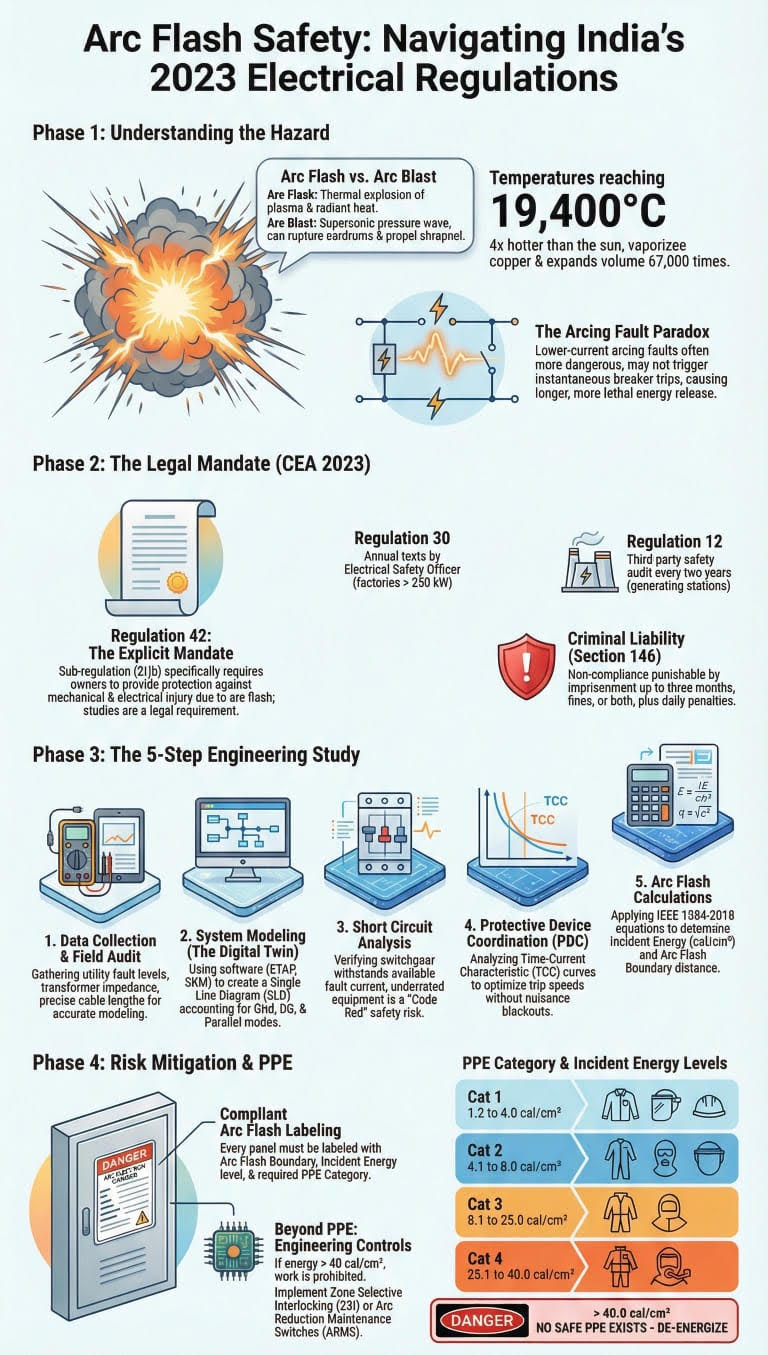
An Arc Flash is a thermodynamic explosion—essentially, a short circuit that occurs through the air. This event is the primary thermal hazard associated with an electrical fault, often called an 'invisible fire' because the true danger is the radiant thermal energy, not just the visible light.
The mechanism is powerful and simple: air, which is normally a very effective electrical insulator, becomes ionized by a high-voltage potential. This transforms the air into a superheated plasma that can conduct electricity. As the current flows through this plasma, the plasma itself acts as a resistor, generating an incredible amount of radiant heat based on the principle of I²R heating (current squared times resistance). To put this in perspective, the core temperature of an arc flash can reach 19,400°C (35,000°F), which is four times the surface temperature of the sun.
The primary consequence for a person exposed to this event is severe, life-threatening burns. The intense heat can ignite non-fire-retardant clothing from several feet away, causing catastrophic injury. To quantify this thermal risk, safety professionals measure it in terms of Incident Energy, expressed in calories per square centimeter (cal/cm²).
Analogy: "One cal/cm² is roughly equivalent to the heat of a cigarette lighter held against the finger for one second. The onset of a second-degree burn occurs at approximately 1.2 cal/cm²."
This thermal event, however, is almost always accompanied by a related, but physically different, mechanical hazard.
2. The Arc Blast: The Concussive Force
The Arc Blast is the mechanical hazard of the electrical explosion. It is a supersonic pressure wave generated by the same event that creates the arc flash.
Its mechanism is rooted in the explosive expansion of materials. The extreme heat of the arc flash can instantaneously vaporize metal components, such as copper busbars. When copper turns from a solid to a gas, its volume can expand by a factor of 67,000, creating an incredible concussive force. The physical consequences of this pressure wave are severe:
* It exerts thousands of pounds of force, capable of throwing workers across a room.
* The pressure wave can cause severe internal injuries, such as collapsed lungs or ruptured eardrums.
* It launches molten metal shrapnel and equipment parts, like panel doors, at lethal speeds.
This brings us to a critical limitation of your safety gear that you must never forget:
Standard arc flash PPE does not protect against the blunt force trauma of an arc blast.
While related, the flash and the blast represent two distinct types of danger that must be understood separately.
3. Synthesizing the Hazards: Flash vs. Blast
To summarize the key differences, the following table provides a direct comparison of the Arc Flash and the Arc Blast. This at-a-glance summary can help solidify your understanding of these two distinct phenomena.
Feature Arc Flash (The Thermal Hazard) Arc Blast (The Mechanical Hazard)
Primary Hazard Intense heat and light. A powerful pressure wave and flying shrapnel.
Physical Process Air becoming an electrical plasma, creating radiant heat. Rapid heating of air and explosive vaporization of metal.
Key Danger Severe, life-threatening burns. Blunt force trauma, internal injuries, and impact from debris.
Measurement Quantified as Incident Energy, measured in cal/cm². Not directly calculated in standard studies, but related to energy.
Now that we understand the hazards themselves, we can explore the types of electrical faults that cause them.
4. The Fault Paradox: Why Less Current Can Be More Dangerous
Understanding the type of electrical fault is critical to understanding the real-world risk of an arc flash. Not all short circuits are equal, and the one with the highest current is not always the most dangerous.
4.1 The Bolted Fault
A Bolted Fault occurs when conductors are physically joined with virtually zero impedance, or resistance. Imagine a heavy wrench dropped directly across two large copper busbars—that’s a bolted fault.
This type of fault results in the maximum possible current flow that the system can deliver to that point. This sounds like the worst-case scenario, but there's a key insight: this extremely high current is so large that it typically causes protective devices, like circuit breakers, to trip instantaneously. This rapid shutdown limits the duration of the arc, which in turn limits the total thermal energy released.
4.2 The Arcing Fault
An Arcing Fault is different. In this case, the fault current flows through the arc plasma in the air. This plasma has impedance (resistance), which means the resulting current is lower than the maximum bolted fault current.
4.3 The Critical Insight
Here lies the paradox: the lower current of an arcing fault—a direct result of the resistance of the arc plasma itself—can be far more dangerous.
This is because the current may not be high enough to trigger the circuit breaker's "instantaneous" trip setting, which is designed to react to massive, bolted-fault-level events. Instead, the breaker's internal logic may see the arcing fault as a less urgent condition and wait on a pre-programmed time delay (e.g., 0.5 seconds or more) before tripping.
Since the total energy of an arc flash is a product of both current and time, allowing the arc to persist for even a fraction of a second longer dramatically increases the total incident energy released.
Key Principle: Energy = Power × Time
Think of it this way: The power of the arcing fault is lower (less current), but because the protective device allows it to persist for a much longer time, the total destructive energy released is far greater. A small fire burning for minutes is more destructive than a massive explosion that lasts for a millisecond.
A smaller fault that lasts longer can easily be more destructive than a massive fault that is cleared instantly.
5. Conclusion: Key Takeaways for Your Safety
As you begin your career, you must move beyond the simple concept of electric shock and understand the explosive thermal and mechanical forces present in modern electrical systems.
For maximum retention, remember these three critical insights:
1. Arc Flash vs. Arc Blast: An arc flash is the thermal (heat) hazard that causes severe burns and is measured in incident energy. The arc blast is the mechanical (pressure) hazard that causes physical trauma from a concussive blast and flying debris.
2. The Danger of Time: The duration of an arc is a critical factor in its severity. The longer an arc persists, the more destructive energy it releases.
3. The Fault Paradox: A lower-current arcing fault can be more dangerous than a maximum-current bolted fault. The lower current may fail to trip a protective device instantaneously, allowing the arc to last much longer and release significantly more energy.
Carry this fundamental knowledge with you on every job. Understanding the true nature of these hazards is the first and most important step toward ensuring your personal safety.
We offer a full suite of HSEFS services designed to address your specific challenges and goals :
HSE Consulting & Advisory,
HSE Auditing & Assurance,
HSE Training & Development,
Implementation & Support,
Environmental Services
GST: 24ABDCA0826H1Z3
CIN: U71100GJ2025PTC163795
Copyright 2025. Agni Raksha Niti Engineering Consultancy Services Pvt. Ltd. All Rights Reserved.