

Mon - Sat 9:00 - 17:30
We all make decisions every day. Many are simple and become second nature, like our morning routine. Others are bigger, requiring us to weigh complex situations and alternatives before choosing a path forward. In your professional life, the quality of these decisions can define your success.
In this guide, you will learn to master a powerful, systematic approach that empowers you to make great decisions consistently. This is the skill that will help you lead projects with confidence, resolve team conflicts, and make strategic choices under pressure, turning uncertainty into opportunity.
A "systematic approach" to decision-making is a stage-by-stage method for dealing with situations. Instead of relying on gut feelings alone, you move through a logical sequence to arrive at a well-reasoned conclusion. Following a structured process ensures that your choices are based on sound principles, which is vital when they affect your team, your resources, and your reputation.
Think of this not as a rigid formula, but as a flexible framework to bring clarity to complexity.
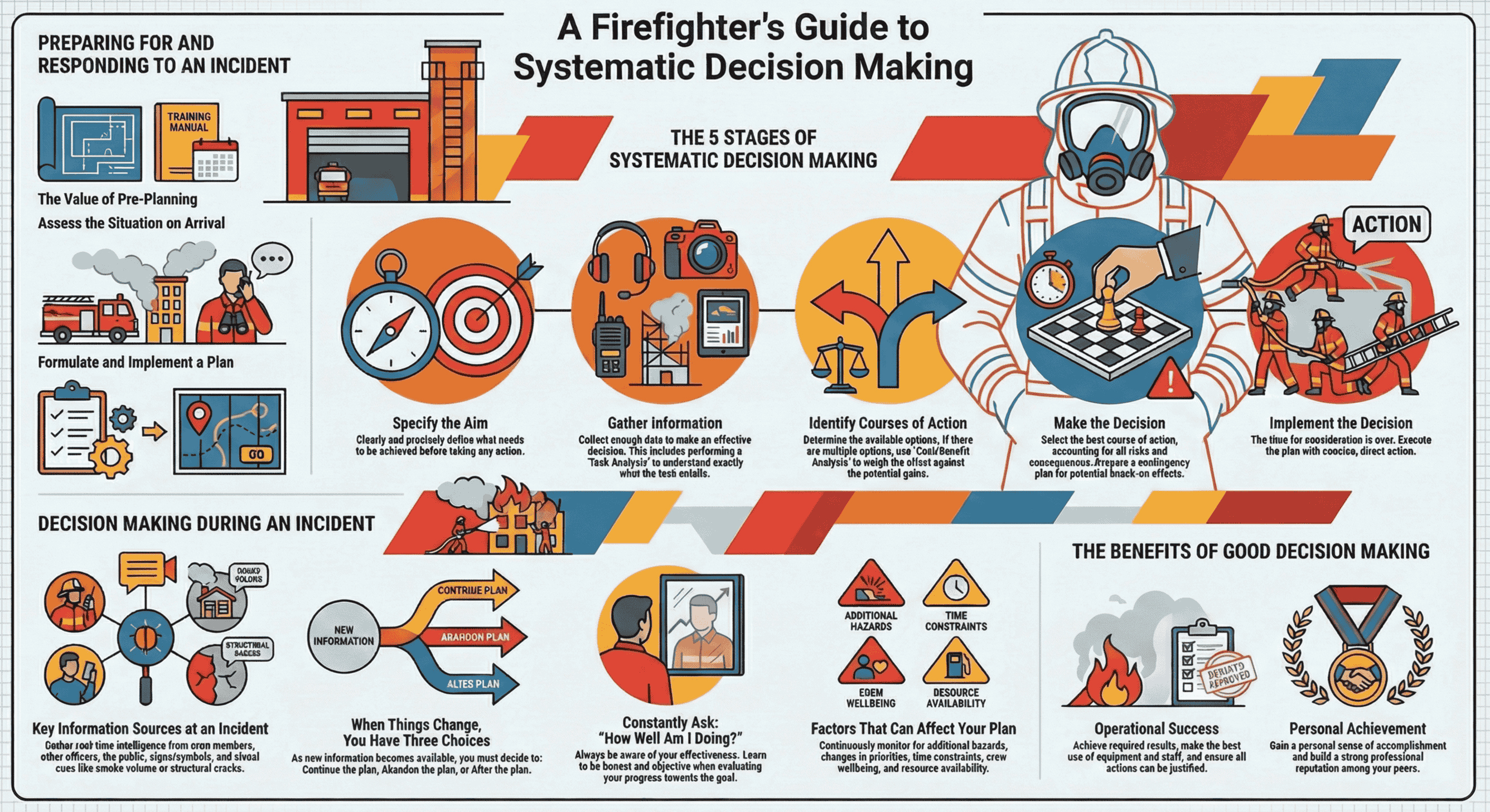
This systematic approach can be broken down into five core stages that will guide you from a problem to its solution.
By following these five stages, you can bring clarity, structure, and confidence to any decision you face.
The first and most critical step is to be absolutely clear about your goal. Before you can find a solution, you must deeply understand the problem. Here's where you empower yourself by asking two fundamental questions:
The word specify is key here—your goal must be precise and well-defined before you can effectively decide how to achieve it. A common pitfall is rushing into action without a clear target.
This is the fact-finding phase. To make a balanced judgment, you must collect enough information; you cannot determine "right" from "wrong" if you only have one side of the story. Information can come from many places: data reports, stakeholder interviews, direct observation, or the expertise of your team members.
This isn't just a reactive process. Great decision-makers engage in proactive "pre-planning" to build a knowledge base before a decision is even required. Activities like market research, competitive analysis, or team skill assessments give you the crucial background knowledge to act decisively when the time comes.
A crucial part of this stage is performing a Task Analysis, which is the process of finding out what you really have to do to achieve the task. This prevents wasted effort on solving the wrong problem and ensures your solution directly addresses the core requirement.
With a clear aim and sufficient information, the next stage is to identify all possible courses of action.
To compare your options effectively, you can use a Cost/Benefit Analysis, which involves balancing the effort you have to put in against the benefits gained. In a professional context, "effort" can mean time, budget, or political capital, while "benefits" could be increased revenue, improved efficiency, or stronger team morale. For instance, you might weigh the cost of a new software subscription against the benefit of saved man-hours.
This is the point of commitment where you make your final choice. This stage is critical for building momentum, but your decision must account for two critical factors:
Thinking about what could happen and preparing for it makes your final decision stronger and more resilient.
This is the final action stage where you put your decision into motion. At this point, "The time for thinking or consideration is over and the action must be concise, straight to the point and to the plan."
But your work isn't done once the plan is in motion. The best decision-makers are also the most adaptable, ready to respond when the world throws a curveball.
Even the best-laid plans can be affected by new information or unexpected events. Imagine you plan a journey and arrive at the Doha bus station only to find that all buses have been cancelled. This new information forces you to alter your plan for getting to your destination.
To know when to adapt, you must constantly monitor your progress. The most important question a leader can ask is also the simplest: "How well am I doing in achieving what I want to achieve?" This honest self-assessment is the trigger that tells you if your current plan is still viable.
When new factors come into play, you are faced with three basic choices:
Being ready and willing to adapt is just as important as the quality of the initial decision itself.
Now that we understand how to make decisions, let's explore why mastering this skill is so valuable for your career.
Making good, decisive choices has clear and tangible benefits, both in the results you achieve and in your own personal and professional development.
|
Practical Outcomes |
Personal Growth |
|
The required results are achieved. |
A personal sense of achievement when things go well. |
|
The best use is made of resources (e.g., equipment and staff). |
The positive impression gained by others of you. |
|
Actions taken can be justified and stand up to questioning. |
Develops skills in making good, sound decisions. |
With these benefits in mind, let's lock in your learning with the key takeaways that will help you put this process into practice.
Use these key points to confirm your understanding and guide your future decisions.

We offer a full suite of HSEFS services designed to address your specific challenges and goals :
HSE Consulting & Advisory,
HSE Auditing & Assurance,
HSE Training & Development,
Implementation & Support,
Environmental Services
GST: 24ABDCA0826H1Z3
CIN: U71100GJ2025PTC163795
Copyright 2025. Agni Raksha Niti Engineering Consultancy Services Pvt. Ltd. All Rights Reserved.