Comprehensive EHS Analysis: Factories Act 1948 (Sections 36 & 36A)
Comprehensive EHS Analysis: Factories Act 1948 (Sections 36 & 36A)
This report provides a detailed breakdown of Sections 36 and 36A of the Indian Factories Act, 1948, their practical application for confined space activities, and their integration with broader EHS management systems.
1. Detailed Breakup: Section 36 (Precautions against dangerous fumes, gases, etc.)
This section is the primary legal statute in India governing confined space entry.
Legal Text (as per the Act):
36. Precautions against dangerous fumes, gases, etc.—
(1) No person shall be required or allowed to enter any chamber, tank, vat, pit, pipe, flue or other confined space in any factory in which any gas, fume, vapour or dust is likely to be present to such an extent as to involve risk to persons being overcome thereby, unless it is provided with a manhole of adequate size or other effective means of egress.
(2) No person shall be required or allowed to enter any confined space as is referred to in sub-section (1), until all practicable measures have been taken to remove any gas, fume, vapour or dust, which may be present so as to bring its level within the permissible limits and to prevent any ingress of such gas, fume, vapour or dust and—
(a) a certificate in writing has been given by a competent person, based on a test carried out by himself, that the space is reasonably free from dangerous gas, fume, vapour or dust; or
(b) such person is wearing suitable breathing apparatus and a belt securely attached to a rope the free end of which is held by a person outside the confined space.
Detailed Explanation:
Subsection 36(1):
- Core Principle: This section establishes a prohibition on entry into any space where a person could be "overcome."
- "No person shall be required or allowed...": This places a dual, absolute responsibility on both management (who "requires" work) and line supervisors (who "allow" entry).
- "...chamber, tank, vat, pit, pipe, flue or other confined space...": This is a broad, inclusive definition. It covers any space that is enclosed and not designed for continuous human occupancy.
- "...likely to be present...": This is a key test. A risk assessment must be done. If there is a possibility of dangerous fumes or oxygen deficiency, the section applies.
- "...risk to persons being overcome...": This hazard isn't just poisoning. It includes:
- Asphyxiation: Lack of oxygen (e.g., from nitrogen purging, rust, or biological decay).
- Toxicity: Presence of toxic gases (H2S, CO, chemical vapours).
- Flammability: Risk of fire or explosion.
- Engulfment: Risk of being buried by a solid (e.g., in a silo or pit).
- "...unless... provided with a manhole of adequate size...": This is the first pre-condition. The space must be able to be exited quickly. State Factory Rules (like Maharashtra's) often define "adequate" (e.g., not less than 45 cm diameter for circular).
Subsection 36(2): This subsection defines the two and only two conditions under which entry is permissible.
- Prerequisite for Both Conditions:
- "...all practicable measures have been taken to remove...": This mandates purging and ventilation to make the space safe.
- "...and to prevent any ingress...": This is the legal requirement for positive isolation. It is not enough to close a valve (which can leak). "Practicable measures" here means:
- Blinding: Inserting a solid "spade" or "blind" into a flange.
- Disconnection: Physically removing a section of pipe.
- Double Block & Bleed: Closing two valves and opening a "bleeder" valve in between to vent any leakage.
- Condition (a): The "Gas-Free" / Certified Entry:
- "...a certificate in writing... by a competent person...": This is the Work Permit.
- "Competent Person": An individual recognized by the Chief Inspector of Factories (CIF) for this specific task. They must have the knowledge and equipment to perform the tests.
- "based on a test carried out by himself": The Competent Person cannot delegate the test. They must personally use a calibrated gas monitor to check for:
- Oxygen Content: (Must be within 19.5% - 23.5%).
- Flammable Gases: (Must be <10% of the Lower Explosive Limit, or LEL).
- Toxic Gases: (Must be below the Permissible Exposure Limit, or PEL, for that specific substance).
- This is the preferred method of entry.
- Condition (b): The "Breathing Apparatus" Entry:
- This is used when the space cannot be made safe (e.g., for rescue, or some specific tasks in an inert atmosphere).
- "...wearing suitable breathing apparatus...": This means a Self-Contained Breathing Apparatus (SCBA) or an airline-fed respirator. It does not mean a simple filter mask, which is useless against oxygen deficiency or high toxic concentrations.
- "...and a belt securely attached to a rope...": This is the retrieval system. Modern standards require a full-body harness, not just a belt.
- "...held by a person outside...": This is the Attendant or Standby Person. Their only job is to monitor the entrant and be ready to initiate a rescue. They must not enter the space themselves.
2. Detailed Breakup: Section 36A (Precautions regarding portable electric light)
This section works in conjunction with Section 36 to control ignition sources.
Legal Text (as per the Act):
[36A. Precautions regarding the use of portable electric light.—
In any factory— (a) no portable electric light or any other electric appliance of voltage exceeding twenty-four volts shall be permitted for use inside any chamber, tank, vat, pit, pipe, flue or other confined space; and
(b) if any inflammable gas, fume or dust is likely to be present in such chamber, tank, vat, pit, pipe, flue or other confined space, no lamp or light other than that of flame-proof construction shall be permitted to be used therein.]
Detailed Explanation:
- Core Principle: To prevent electric shock and ignition of flammable atmospheres.
- Clause (a): Shock Prevention:
- "...voltage exceeding twenty-four volts...": This is a clear, prescriptive rule. It mandates the use of 24V (or less) "extra-low voltage" lighting.
- Reason: The human body's resistance is lower in damp or humid conditions (common in confined spaces). A 240V shock can be fatal, whereas a 24V shock is generally not. This light should be powered via a step-down isolation transformer.
- Clause (b): Ignition Prevention:
- "...if any inflammable gas... is likely to be present...": This links back to the risk assessment. If the LEL test (from Sec 36) showed 0%, but the risk assessment says a flammable atmosphere could develop (e.g., from sludge or scale), this clause applies.
- "...flame-proof construction...": This is a technical requirement. The equipment must be certified (e.g., by PESO, or to IS/IEC standards) as "flame-proof" (Ex 'd') or "intrinsically safe" (Ex 'i'). This means the equipment is designed so it cannot create a spark or hot surface capable of igniting the flammable atmosphere.
- Combined Rule: For a confined space in a chemical plant that contained a flammable liquid, both clauses apply. The EHS team must provide a portable lamp that is both 24V and Flame-Proof.
3. Other Reference Rules and Acts
Compliance with Sec 36 & 36A is supported by a web of other legislation.
- State Factory Rules (e.g., Maharashtra Factories Rules, 1963; Gujarat Factories Rules, 1963):
- The Act is a central law, but states write their own rules to detail the how.
- Linkage: These rules provide the specific details for Sec 36. For example, Rule 68 of the Maharashtra Rules specifics:
- Manhole dimensions.
- Precise O2, LEL, and PEL limits.
- Requirements for training and Standard Operating Procedures (SOPs).
- Mandating a formal Work Permit system.
- Duties of the attendant.
- The Manufacture, Storage and Import of Hazardous Chemical (MSIHC) Rules, 1989:
- Linkage: For chemical plants, these rules are paramount. They mandate that the occupier must conduct a full Risk Assessment (e.g., HAZOP) and prepare SOPs and Emergency Plans. The procedure for confined space entry (to comply with Sec 36) is a critical SOP under the MSIHC rules.
- The Petroleum Rules, 2002:
- Linkage: If the factory handles petroleum products, these rules apply. They have stringent requirements for "flame-proof" (Ex-rated) electrical equipment, which directly supports Sec 36A(b).
- Central Electricity Authority (Measures relating to Safety and Electric Supply) Regulations:
- Linkage: These regulations provide the legal and technical standards for electrical safety, including specifications for extra-low voltage systems and flame-proof apparatus, supporting compliance with Sec 36A.
4. EHS Team's Role & Regular Compliance Checklist
The EHS team must transition these legal requirements into a continuous, practical system.
A. Foundational Activities (One-Time & Periodic Review):
- Identification: Create and maintain a master register of all identified confined spaces on site.
- Risk Assessment: For each space, maintain a risk assessment document detailing potential hazards (toxic, flammable, asphyxiation, engulfment, etc.).
- Procedure: Develop, review, and update a formal, written "Confined Space Entry SOP" and a "Confined Space Entry Permit" form that incorporates all requirements of Sec 36, 36A, and State Rules.
- Competency: Identify and maintain a list of "Competent Persons" (for gas testing) and "Authorized Entrants/Attendants" (for work). Ensure their training and certification are up-to-date.
- Equipment: Procure, maintain, and certify all required equipment:
- Calibrated, multi-gas monitors (O2, LEL, H2S, CO, etc.).
- SCBAs and/or airline respirators.
- Retrieval systems (full-body harnesses, tripods, winches).
- 24V, Ex-rated portable lighting.
- Ventilation fans (Ex-rated if needed).
- Positive isolation gear (blinds, spades).
B. Regular (e.g., Quarterly/Annual) Compliance Activities:
- Equipment Calibration: Ensure all gas monitors are sent for calibration as per manufacturer's schedule (and bump-tested before each day's use).
- Equipment Inspection: Conduct formal, documented inspections of all SCBAs, harnesses, and retrieval systems.
- Training: Conduct refresher training for all entrants, attendants, supervisors, and competent persons.
- Drills: Conduct periodic confined space rescue drills.
- Audits: Perform internal audits by reviewing a sample of all "Closed" CSE permits to check for proper completion, gas test results, and signatures.
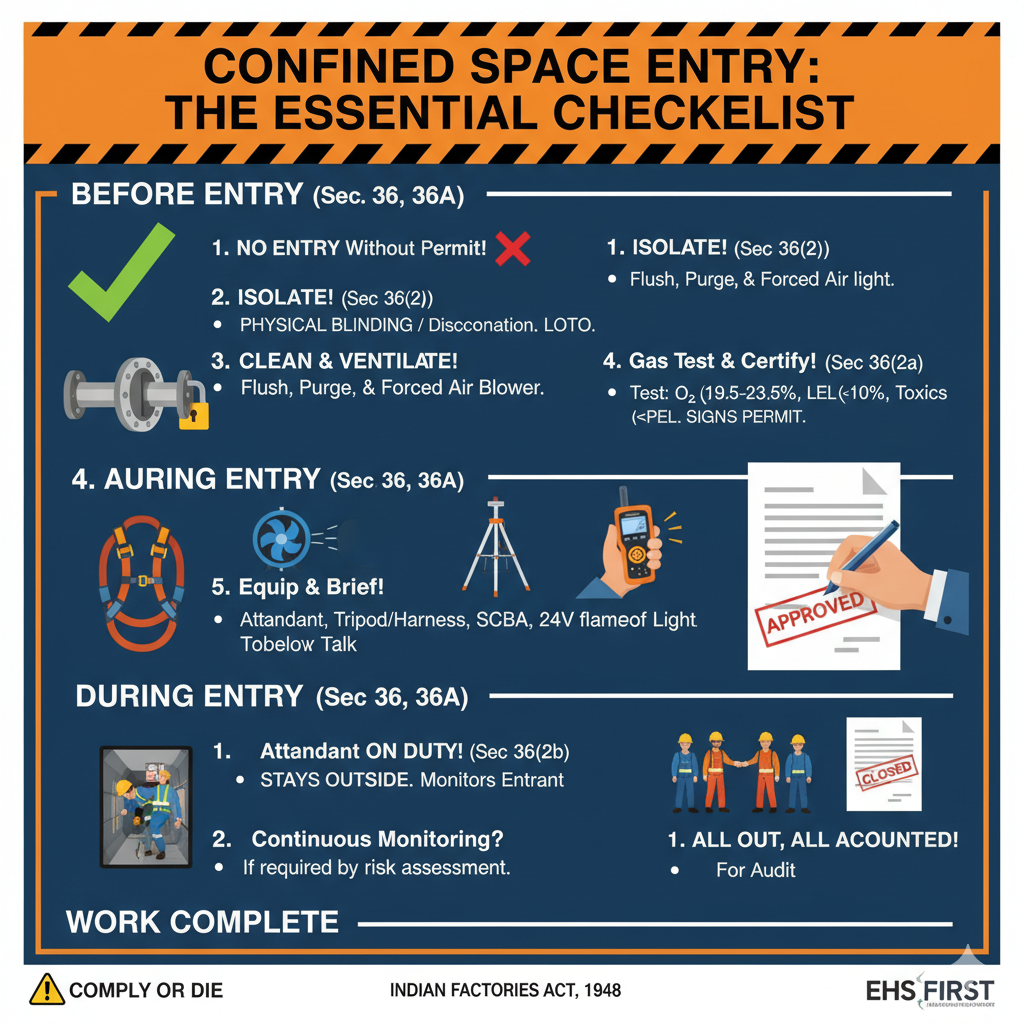
C. Per-Entry Compliance Checklist (The "Permit" Process):
- [ ] 1. Justification: Is entry absolutely necessary? Can the job be done from outside?
- [ ] 2. Permit Initiated: A formal permit request is raised by the maintenance/operations supervisor.
- [ ] 3. Isolation:
- [ ] Mechanical: Space is positively isolated (blinded/disconnected). LOTO applied.
- [ ] Electrical: All electrical equipment (e.g., agitators) is locked-out.
- [ ] 4. Cleaning: Space is emptied, depressurized, flushed, and purged (e.g., with water, steam, or air).
- [ ] 5. Ventilation: Forced ventilation (e.g., air blower) is set up and running.
- [ ] 6. Competent Person Test:
- [ ] Competent Person (by name) arrives with a calibrated monitor.
- [ ] Tests atmosphere at multiple levels (top, middle, bottom).
- [ ] Records results on permit:
- Oxygen: ____% (Limit: 19.5-23.5%)
- LEL: ____% (Limit: <10%)
- Toxics (e.g., H2S): ___ ppm (Limit: <PEL)
- [ ] Competent Person signs the certificate [Sec 36(2)(a)].
- [ ] 7. Equipment at Site:
- [ ] Attendant is present and identified.
- [ ] Retrieval system (tripod, harness) is in place.
- [ ] SCBA (for entry/rescue) is present.
- [ ] 24V / Ex-rated lighting is provided [Sec 36A].
- [ ] Fire extinguisher / fire watch (if hot work is involved).
- [ ] 8. Pre-Entry Briefing: Supervisor holds a toolbox talk with entrants and attendant.
- [ ] 9. Authorize Entry: Supervisor signs the permit to authorize work.
- [ ] 10. During Entry:
- [ ] Attendant is continuously present, monitoring entrants.
- [ ] Continuous/periodic gas monitoring is performed (if risk assessment demands it).
- [ ] 11. Work Completion:
- [ ] Entrants exit, tools removed.
- [ ] Supervisor and Attendant sign off.
- [ ] Permit is closed and filed for audit.
5. Applicability to Confined Space Related Activities
Sections 36 and 36A are the legal foundation for all confined space entry procedures in an Indian factory. They are not just guidelines; they are the law.
- Sec 36(1) defines the spaces you must manage (reactors, vessels, tanks, pits).
- Sec 36(2) defines the entire procedure:
- "prevent any ingress" = The Isolation step (blinding).
- "remove any gas" = The Purging & Ventilation step.
- "certificate... by a competent person" = The Work Permit & Gas Testing step.
- "wearing suitable breathing apparatus" = The Contingency Plan (SCBA entry).
- "belt... rope... held by a person outside" = The Attendant & Rescue plan.
- Sec 36A defines the equipment you must use to prevent:
- (a) Electrocution (by mandating 24V).
- (b) Explosions (by mandating flame-proof equipment).
Without these sections, a "confined space" would have no specific legal definition or mandatory procedure in the Act.
6. Statistics of Violation and Tentative Fines
- Statistics: Specific, nationwide statistics isolating violations of only Section 36 are not readily published by government bodies (like the Labour Bureau). Statistics are often aggregated by "unsafe acts" or "accidents" (e.g., "asphyxiation," "chemical exposure"). However, confined space fatalities are a well-documented and recurring high-hazard event in Indian industries, frequently linked to direct non-compliance with Sec 36 (e.g., no gas test, no attendant, no isolation).
- Fines (Penalties): The Factories Act does not list a separate fine for each section. Instead, it uses a "General Penalty" clause.
- Section 92: General penalty for offences:
- For any contravention of the Act (e.g., failing to comply with Sec 36), the Occupier and Manager are each liable.
- Penalty: Imprisonment for a term up to two years or a fine up to one lakh rupees (₹1,00,000), or both.
- Section 94: Enhanced penalty after previous conviction:
- If an offense under Sec 92 is repeated, the penalty increases.
- Section 96-A: Penalty for contravention of provisions of sections 41B, 41C and 41H (Hazardous Processes):
- Since confined space entry in a chemical plant is part of a "hazardous process," these penalties may also apply, which are more severe.
Tentative Fine: The "tentative fine" for a first offense is up to ₹1,00,000 per responsible person (Occupier/Manager) plus potential imprisonment. However, if a fatality or serious injury occurs due to this non-compliance, the legal consequences become far more severe, including mandatory imprisonment and potential for prosecution under the Indian Penal Code (IPC) for criminal negligence. The financial penalty is often secondary to the criminal liability.
7. Step-by-Step Implementation Guide (Chemical Process Industries)
- Policy & Commitment: Management drafts and signs a "Confined Space Entry Policy" stating that no entry is permitted without a valid permit and full compliance.
- Identification: A cross-functional team (EHS, Engineering, Operations) walks the plant and creates a master register of all confined spaces (reactors, columns, tanks, vessels, pits, sumps, etc.). Each space is tagged with a unique ID.
- Hazard Assessment: For each space, document the specific hazards:
- Chemicals: What was in it? (e.g., Benzene - toxic, flammable; Nitrogen - asphyxiant).
- Physical: Agitator blades, steam coils (heat), engulfment risk (catalyst bed).
- Atmospheric: Can it be oxygen-deficient? Can H2S form?
- Procedure Development: Draft the formal CSE SOP based on the checklist in section 4. This SOP must mandate positive isolation (blinding/disconnection) for all lines.
- Permit Design: Create a multi-part "Confined Space Entry Permit" form. This form is the "certificate" required by Sec 36(2)(a). It must have signature lines for:
- Issuer (Operations)
- Competent Person (Gas Tester)
- Entrant(s)
- Attendant
- Closer (Supervisor)
- Resource Allocation:
- Equipment: Procure all equipment (multi-gas monitors, 24V Ex-lights, SCBAs, tripods).
- Personnel: Identify and train a corps of "Competent Persons," "Attendants," and "Entrants." Crucially, the "Attendant" must be trained that their only job is to attend.
- Training & Rollout:
- Conduct plant-wide awareness training on the new CSE policy.
- Conduct intensive, hands-on training for the "Competent Persons" (gas monitor use), "Entrants" (SCBA use, hazards), and "Attendants" (rescue procedures, communication).
- Execution: Enforce a "zero tolerance" policy. Any work in a confined space must have a posted, valid permit at the entrance.
- Audit & Review:
- The EHS team must periodically audit the system.
- After every CSE job, the closed permit must be reviewed by EHS for compliance.
- Annually, the entire SOP and policy must be reviewed and updated.
8. Best Practices & Linkage to AIChE RBPS
The law (Sec 36) sets the minimum. Best practices (often from AIChE) aim for maximum safety.
- Best Practice 1: Elimination: The best CSE is no CSE. Use robotics, cameras (e.g., "smart-ball"), or remote-cleaning technology (e.g., high-pressure jets) to avoid human entry.
- Best Practice 2: Positive Isolation: The industry best practice requires blinds or physical disconnection. Relying only on a locked valve (LOTO) is considered poor practice and does not meet the "prevent any ingress" intent of Sec 36.
- Best Practice 3: Continuous Monitoring: The law requires a pre-entry test. Best practice is to place a continuous multi-gas monitor inside the space with the entrants, with an external alarm for the attendant.
Linkage to AIChE Risk-Based Process Safety (RBPS): Confined space entry is a classic high-hazard "non-routine task" that is a core focus of RBPS.
- Element: Safe Work Practices: CSE is the archetype of a Safe Work Practice. This RBPS element is dedicated to establishing procedures and permits (like CSE permits, hot work permits) to control hazards during maintenance and other non-routine work.
- Element: Process Knowledge Management: You cannot comply with Sec 36 without this. To know the hazards, you need to know what was in the tank (P&IDs, chemical data, MSDS). This element ensures that knowledge is available.
- Element: Hazard Identification & Risk Analysis (HIRA): This element is the foundation. It's the process you use to identify your confined spaces (Part 1) and their specific hazards (Part 2) in the first place.
- Element: Operating Procedures: While CSE is a "safe work practice," the procedures for preparing the space (e.g., "Reactor Cleaning Procedure") are covered by this element.
9. Linkage to Responsible Care® (RC) Practices
Responsible Care® is a voluntary chemical industry initiative to exceed legal EHS requirements.
- Linkage: Compliance with Sec 36 & 36A is the absolute minimum baseline for any company claiming to follow Responsible Care.
- RC Codes: A robust CSE program is a direct expression of the Process Safety Code and the Employee Health & Safety Code within the Responsible Care Management System (RCMS).
- Monitoring:
- Internal Monitoring: The company's internal EHS/RC audit team must audit the CSE program (e.g., check permit records, inspect equipment, interview staff) to ensure it is effective.
- Self-Assessment: Companies must perform annual self-assessments against the RCMS, which would include metrics related to safe work practices.
- Third-Party Verification: To maintain their RC certification, companies undergo periodic audits by external, certified auditors. The auditor will review high-hazard programs like CSE. A weak or non-compliant CSE program would be a major non-conformance, putting their RC status at risk.
- Performance Metrics: The RCMS requires tracking performance. A near-miss or incident during a confined space entry would be a key "lagging indicator," triggering a mandatory root cause analysis (RCA) and system-wide corrective actions.