

Mon - Sat 9:00 - 17:30
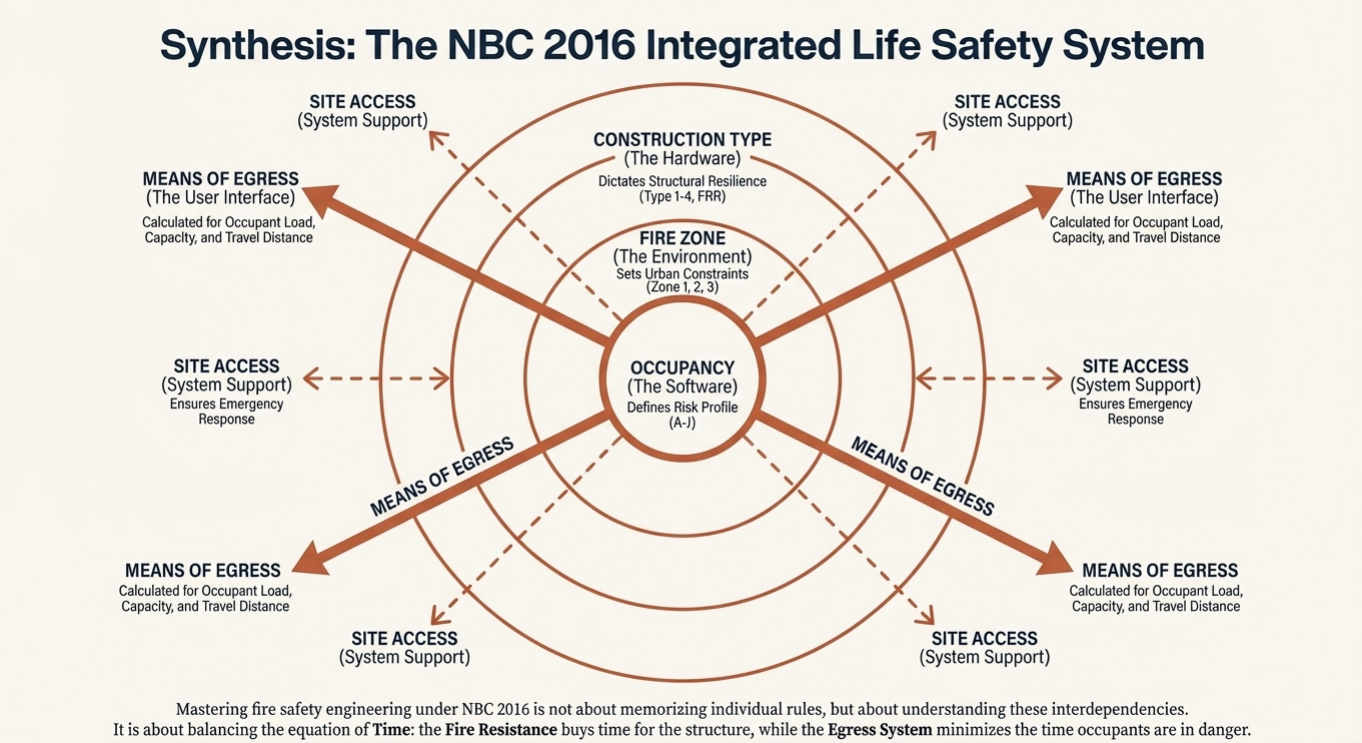
Most professionals treat the National Building Code (NBC) 2016 as a rigid set of rules to be memorized. This diagram reveals the truth: fire safety is a high-performance Integrated System.
If you’re an architect, engineer, or developer, you need to view fire safety through a "Systems Thinking" lens. Here’s the breakdown:
Occupancy (The Software): This is the core. It defines the risk profile (Group A-J). Your "software" dictates what the rest of the system must handle.
Construction Type (The Hardware): This is your structural "chassis." It dictates structural resilience and Fire Resistance Ratings (FRR).
Means of Egress (The User Interface): This is how the "users" interact with the building during a crisis. It must be intuitive and high-capacity.
Fire Zone (The Environment): Sets the urban constraints (Zone 1, 2, or 3).
Site Access (System Support): Ensures that when the system is under stress, emergency response can actually reach and support it.
To make the "UI" work, the NBC requires three critical calculations to ensure the "software" (occupants) can exit before the "hardware" (structure) fails:
Occupant Load (The Demand): We don't just guess how many people are in a room. We calculate based on the Occupant Load Factor (sqm per person).
High Density (e.g., Assembly): Requires wider exits and more doors.
Low Density (e.g., Storage): Focuses more on travel distance than width.
Capacity (The Bandwidth): Once we know the load, we determine the Width per Person. NBC specifies clear widths for stairways (usually 10mm per person) and doors/corridors (7mm per person). If your "bandwidth" is too narrow, you create a bottleneck that costs lives.
Travel Distance (The Time Limit): This is the maximum distance an occupant must travel to reach a "protected" exit.
Residential/Business: Usually allows for longer distances.
Hazardous/High-Rise: Distances are strictly shortened.
Pro-tip: Installing a sprinkler system can often "buy" you extra travel distance, showing how the hardware (sprinklers) supports the UI (egress).
Fire safety engineering is a race against the clock. The goal is simple: ASET (Available Safe Egress Time) > RSET (Required Safe Egress Time)
Fire Resistance buys time for the structure to stay standing (ASET).
Egress Systems minimize the time occupants spend in danger (RSET).
The Bottom Line: Mastering NBC 2016 is about balancing these variables, not just checking boxes. When you understand the interdependencies, you design buildings that are not just compliant, but truly resilient.
#FireSafety #Architecture #Engineering #NBC2016 #LifeSafety #BuildingCodes #SystemsThinking #RealEstateDevelopment #SafetyFirst

We offer a full suite of HSEFS services designed to address your specific challenges and goals :
HSE Consulting & Advisory,
HSE Auditing & Assurance,
HSE Training & Development,
Implementation & Support,
Environmental Services
GST: 24ABDCA0826H1Z3
CIN: U71100GJ2025PTC163795
Copyright 2025. Agni Raksha Niti Engineering Consultancy Services Pvt. Ltd. All Rights Reserved.