

Mon - Sat 9:00 - 17:30
The paper and pulp industry transforms raw fibrous materials (mainly wood or recycled paper) into pulp and then into finished paper products. The major stages include:
Raw Material Preparation & Storage – Logs, wood chips, or recycled paper are stored before processing.
Pulping – Mechanical or chemical processes break down wood fibres into pulp.
Stock Preparation – Pulp is cleaned, refined, and mixed with additives.
Paper Forming – The fibre slurry is drained and formed into a continuous paper web on a paper machine.
Pressing & Drying – Excess water is removed and the sheet is dried with heated rollers.
Finishing & Reels – Paper is smoothed, coated, rewound into reels, and cut to size.
Storage & Dispatch – Finished reels and products are warehoused for shipment.
At each step, specific machinery, heat, and combustible materials interact in a complex industrial environment.
Each manufacturing stage carries distinct fire risks:
Hazards: Wood chips, bales, and recycled paper are highly combustible. Loose fibres and gaps between stacked bales can act as chimneys, enabling rapid flame and smoke spread.
Risk Sources: Spontaneous combustion in large stacks; external ignition from hot surfaces. (The Big Red Guide)
Hazards: Pulping digesters use high-temperature chemical reactions, producing volatile compounds and heat.
Risk Sources: Overheated chemicals, friction, mechanical breakdowns. These conditions can ignite combustible vapours or materials. (TÜV SÜD)
Hazards: Conveyors, grinders, and refiners generate dust and heat.
Risk Sources: Dust accumulation, overheated bearings, sparks from machinery. (Hegel Eng. Sdn Bhd)
Hazards: Dryers operate at high temperatures; drying paper surfaces become highly combustible as moisture reduces.
Risk Sources: Hot surfaces, static electricity, and rapid drying create ideal ignition conditions. (Hegel Eng. Sdn Bhd)
Hazards: Continuous heat and mechanical friction.
Risk Sources: Belts and bearings overheating, static sparks, dust cloud formation. › (Salgrom)
Hazards: Cutting, trimming, and packaging release fine dust that is both combustible and explosive.
Risk Sources: Dust concentration in filters, cyclones, or air handling systems. (Stonehouse Process Safety)
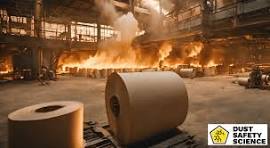
Hazards: Finished rolls of paper and pulp products are fuel for intense fires.
Risk Sources: Electrical faults near dense stacks; poor housekeeping increases risk. (The Big Red Guide)
Industrial fires in paper and pulp facilities have occurred worldwide, highlighting systemic vulnerabilities:
Resolute Forest Products Mill (USA): A massive fire at a pulp warehouse spread through stacked recovered paper bales, requiring extensive firefighting support over days. (Recycling Today)
Des Moines Paper Mill (Iowa): Firefighters battled a blaze in December 2024 where machinery or stored materials ignited, necessitating external firefighting assistance. (Fire Engineering)
Sydney Paper Mill (Australia): A major fire forced evacuation and extensive emergency response due to large quantities of paper and strong winds spreading fire. (News.com.au)
Ludhiana Paper Mill (India): A blaze ignited inside a mill storage area, burning through stocked materials and requiring prolonged fire brigade efforts. (The Times of India)
These examples emphasize rapid fire spread due to high fuel loads, dust accumulation, and limited early detection.
Effective fire protection in paper and pulp plants relies on a combination of national codes (e.g., Indian Standards / BIS, National Building Code) and international standards such as NFPA (National Fire Protection Association) and EN (European Norms).
Fire Alarm & Detection: Smoke, heat, and flame detection per NFPA 72 or EN54 for early detection, especially in challenging dusty or humid zones. (The Big Red Guide)
Video Detection: Advanced technologies like video fire detection (VFD) are recommended where traditional sensors fail due to dust. (Hegel Eng. Sdn Bhd)
Per NFPA 13 (sprinkler systems), NFPA 15 (water spray), and relevant BIS standards (e.g., IS 15105) for automated water-based suppression tailored to zones like paper storage, stock prep, and paper machines. (NFPA)
Foam & Mist Systems: For areas with flammable liquids or coating lines (NFPA 750/NFPA 11). (IPPTA)
Clean-Agent Systems: For electrical rooms or MCCs, using agents like FM-200 or Novec 1230 per NFPA 2001 and IS 15325. (IPPTA)
Systems that detect sparks in conveyor and ventilation lines—and neutralize them before ignition—are essential in dust-prone paper processing. (Wikipedia)
Fire-resistant construction, compartmentation, and fire doors help contain fire spread and protect structural integrity in compliance with NBC 2016 and industry norms.
Housekeeping to prevent dust and fibre buildup, proper insulation on pipes, and routine equipment checks significantly reduce ignition sources. (Hegel Eng. Sdn Bhd)
Agni Raksha Niti (fire defense policy) encapsulates a risk-based, standards-aligned strategy for industrial fire safety, including pulp and paper plants:
Conduct detailed hazard identification and dust hazard analysis in combustible dust zones.
Prioritize zones like dryers, storage, and stock prep where heat and fuel coincide.
Align detection, suppression, and passive protection systems with NFPA codes (e.g., NFPA 13, 15, 72, 2001) and Indian codes/BIS standards to ensure robust protection infrastructure.
Deploy a blend of sprinkler, water spray, foam systems, and clean-agent suppression based on hazard classification and chemical exposure.
Implement regular fire drills, emergency response planning, and operator training to ensure readiness.
Schedule rigorous cleanup, filter cleaning, insulation checks, and vibration monitoring to prevent ignition from friction or dust accumulation.
Use real incident data to refine systems, update risk assessments, and adopt innovative technologies for early fire detection.
This policy emphasizes proactive prevention, standard compliance, and effective emergency response to protect life, assets, and continuity of operation.
The paper and pulp manufacturing sector faces significant fire hazards due to combustible materials, heat-intensive processes, and complex machinery. Recognizing risk areas, learning from past incidents, and adopting a robust fire protection system—aligned with NFPA standards, BIS/NBC guidelines, and Agni Raksha Niti principles—are essential to safeguarding facilities and personnel.

We offer a full suite of HSEFS services designed to address your specific challenges and goals :
HSE Consulting & Advisory,
HSE Auditing & Assurance,
HSE Training & Development,
Implementation & Support,
Environmental Services
GST: 24ABDCA0826H1Z3
CIN: U71100GJ2025PTC163795
Copyright 2025. Agni Raksha Niti Engineering Consultancy Services Pvt. Ltd. All Rights Reserved.