

Mon - Sat 9:00 - 17:30
The tire industry is a critical segment of the global automotive and transport sectors. Tires are essential components for vehicles — from two-wheelers and cars to heavy trucks, buses, agricultural machinery, and industrial equipment — providing traction, durability, load-carrying capacity, and safety. The industry has grown rapidly to meet rising demand driven by mobility, logistics, and replacement markets.
In India, the tire manufacturing sector has seen significant development with both domestic and multinational players setting up state-of-the-art facilities for passenger, commercial, and off-the-road (OTR) tires.
However, alongside operational scale comes associated risks, particularly fire hazards, due to the flammable nature of tire materials and storage volumes.
Tire manufacturing is a complex, multi-stage industrial process involving raw materials, compounding, assembly, curing, and inspection. Below is a simplified process flow:
Tires are made from a blend of:
Natural and synthetic rubber
Carbon black and fillers
Chemicals and additives
Steel and textile reinforcement cords
These ingredients are weighed, mixed, and compounded to achieve the required performance characteristics.
The raw ingredients are processed in mixers to produce various rubber compounds for different parts of the tire (tread, sidewall, beads). Heat and shear in mixers ensure proper dispersion of ingredients.
Individual tire components are formed:
Tread — provides traction and wear resistance
Sidewalls — protect against impacts and maintain structure
Belts and plies — steel and textile layers for strength
Beads — hold the tire on the wheel rim
A specialized tire building machine assembles all components into an uncured tire “green” structure, layer by layer.
The uncured tire is cured in a press under heat and pressure. This vulcanization process chemically bonds rubber molecules, giving the tire its final shape and performance.
Finished tires undergo rigorous inspection and testing before dispatch.
Fire risks exist throughout this workflow — from compounding flammable liquids to mechanical heat generation in mixers and presses. (Risk Logic)
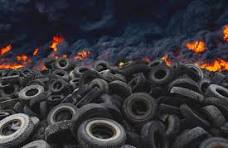
Tire fires are notorious once they start:
Recent tire warehouse fire near Gurgaon, India: A fire broke out in a large tire storage area, producing dense smoke and challenging firefighting efforts. Several fire tenders were deployed to control it. (The Times of India)
Hagersville Tire Fire (Ontario, Canada): A massive tire fire consumed about 14 million tires and burned for 17 days, requiring significant firefighting efforts and environmental cleanup. (Wikipedia)
Tires burn intensely and produce:
Dense black smoke
Toxic gases (carbon oxides, hydrocarbons)
High heat release rates and fire that is difficult to extinguish once established (michelin.in)
Despite not easily igniting, once tyres catch fire they can:
Burn with sustained heat and dense toxic smoke
Be difficult to extinguish due to rubber’s heat-retention and insulation properties
Re-ignite after suppression due to internal heat build-up (michelin.in)
Ignitable liquids and flammable chemicals used in compounding stages (Risk Logic)
Combustible dust from re-tread and cutting operations (Risk Logic)
Stored finished tires, especially when stacked vertically, can create a “chimney effect” that accelerates fire spread (Risk Logic)
Spontaneous heating of rubber shreds or stockpiles in recycling or storage areas (HSE)
Ensuring fire safety requires adherence to codes and standards that prescribe fire detection, suppression, and life safety.
National Building Code (NBC) – Part IV: Provides comprehensive fire & life safety guidance for building design, passive and active fire protection systems in industrial facilities, and integration of safety engineering principles. (Shubh Fire and Safety Equipments)
IS 3594: Code of Practice for Fire Safety of Industrial Buildings: Details fire protection requirements for warehouses and storage buildings — including compartmentation, sprinkler requirements, means of egress, and safe storage of materials. (Law Resource)
Other relevant BIS standards: Include codes for fire extinguishers (IS 2190), alarm systems (IS 2189), water spray systems (IS 15325), and safety signage (IS 12349). (gidm.gujarat.gov.in)
Local Fire Safety Bylaws and Model Building Bye-laws often enforce NBC provisions in practice. (Ministry of Housing and Urban Affairs)
International Fire Code (IFC): Includes provisions specific to tire storage and tire rebuilding plants and references sprinkler system standards like NFPA 13. (ICC Digital Codes)
NFPA 13 — Standard for the Installation of Sprinkler Systems: Addresses design of sprinkler protection for storage and special hazards—including rubber tire storage arrangements and commodity classifications. (Multiscreensite)
NFPA and fire codes generally provide guidelines for fire detection, fire alarms, safe egress, and fire suppression in industrial settings. (NFPA)
Key fire protection principles include:
Segregated storage with safe pile heights and separation distances
Automatic sprinkler systems appropriate for hazardous occupancies
Fire detection and alarm systems
Adequate access for emergency responders
Regular inspection, maintenance, and staff training
Proper tire storage minimizes fire risk:
Maintain clear aisle space and limit pile height
Store tires on racks or on-side rather than vertical stacks
Provide access routes and ensure separation between piles and buildings
Equip warehouses with automatic sprinklers, hydrants, and portable extinguishers (Red River Mutual)
Modern fire safety practice also includes:
Early fire detection technologies (e.g., advanced detectors and panels)
Integration of alarm systems with suppression controls
Emergency response planning and drills
Industrial sites like tire manufacturing plants use scalable fire detection systems combining detectors, manual call points, and integrated alarms to quickly identify and respond to fire events. (boschsecurity.com)
Tire fires not only disrupt operations but can:
Cause major property loss
Release toxic pollution
Pose risk to workers and surrounding communities
Lead to heavy environmental cleanup costs
For example, large tire fires have historically required extensive firefighting resources and long containment efforts due to heat retention and complex fire dynamics. (Wikipedia)
Agni Raksha Niti emerges as a holistic solution for tire industry fire risks, offering:
🔹 Fire Risk Assessment & Audit: Identifying hazards in manufacturing and storage workflows.
🔹 Fire Protection Engineering: Designing compliant fire safety systems per Indian and international standards.
🔹 Advanced Detection & Suppression Solutions: Fire alarms, detectors, sprinklers, and integrated emergency systems.
🔹 Emergency Response Planning: Customized strategies and training to protect life and assets.
🔹 Compliance Support: Ensuring adherence with NBC, BIS codes, NFPA and IFC guidelines.
As previously discussed in other materials, Agni Raksha Niti brings end-to-end fire safety planning, implementation, and compliance under one umbrella — minimizing risk while enabling operational continuity and regulatory adherence.
The tire industry’s growth and complexity bring inherent fire risks — in manufacturing, handling of chemical materials, and bulk storage of finished tires. Understanding the manufacturing process, fire behavior of tire materials, and fire protection standards is essential for risk mitigation.
Adhering to Indian codes like the National Building Code and relevant BIS fire safety standards, along with international standards such as the International Fire Code and NFPA 13, provides a strong foundation for fire safety. However, proactive fire protection design, monitoring, and emergency planning are equally critical.
Agni Raksha Niti offers a comprehensive solution tailored to the tire sector’s unique hazards — from risk assessment to system implementation — ensuring safety, compliance, and resilience.

We offer a full suite of HSEFS services designed to address your specific challenges and goals :
HSE Consulting & Advisory,
HSE Auditing & Assurance,
HSE Training & Development,
Implementation & Support,
Environmental Services
GST: 24ABDCA0826H1Z3
CIN: U71100GJ2025PTC163795
Copyright 2025. Agni Raksha Niti Engineering Consultancy Services Pvt. Ltd. All Rights Reserved.