
Mon - Sat 9:00 - 17:30
1. Why Third-Party Inspection of Vessels is Mandatory
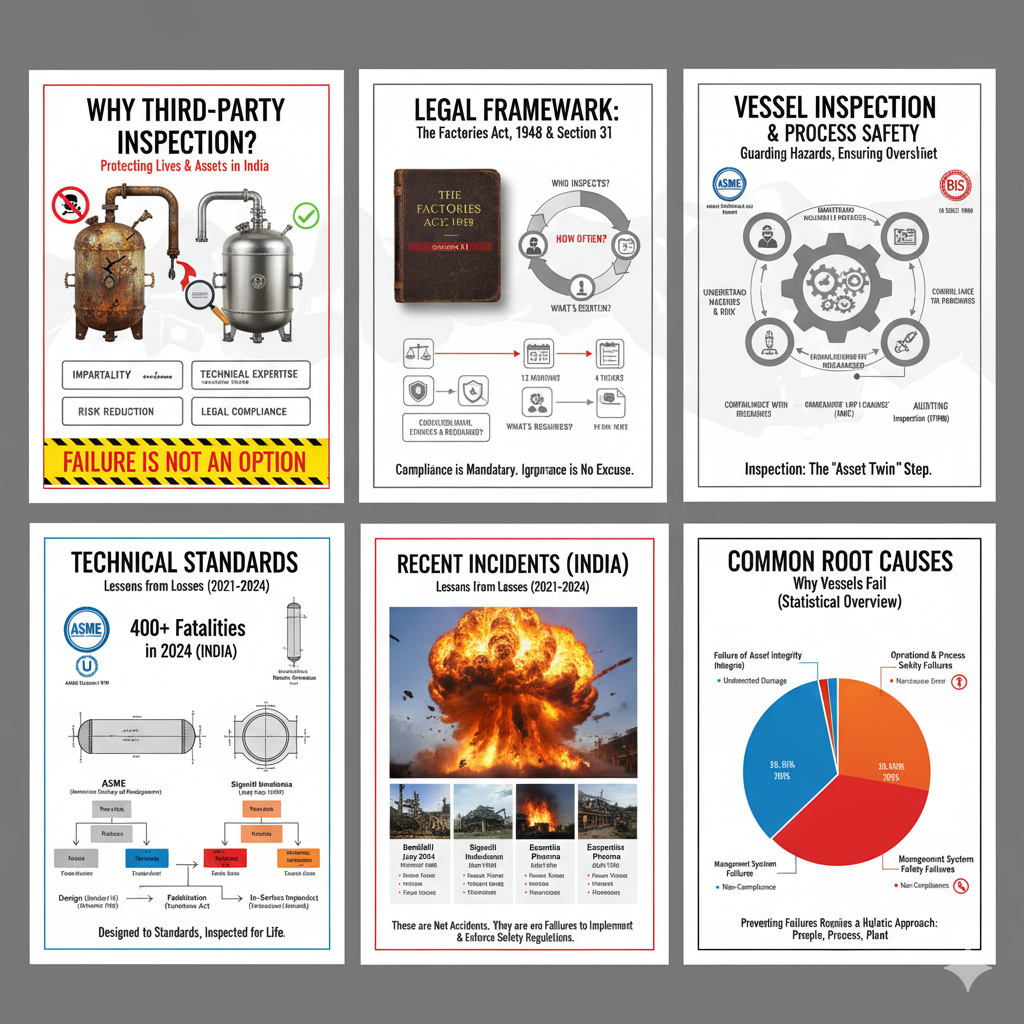
Third-party inspection of pressure vessels and plants is mandatory in India primarily to ensure safety and prevent catastrophic failures. The core reasons are:
Impartiality: A "Competent Person" (the third-party inspector) is an independent, certified entity. They provide an unbiased assessment without the internal conflict of interest a company might face (e.g., pressure to avoid costly shutdowns).
Technical Expertise: These inspectors are certified by the Chief Inspector of Factories and possess specialized knowledge, training, and equipment (like Non-Destructive Testing tools) to properly assess vessel integrity.
High-Risk Reduction: Vessels operate under significant pressure, often with high temperatures or hazardous contents. A small defect, crack, or corrosion patch can lead to a violent explosion, major fire, or toxic leak. The inspection is designed to find these flaws before they fail.
Legal Compliance: It is a non-negotiable legal requirement under The Factories Act, 1948. Failure to comply can lead to severe penalties, including fines and imprisonment for the factory occupier or manager.
2. The Legal Framework: The Factories Act, 1948
The primary legislation is The Factories Act, 1948. The specific rules are detailed in Section 31: Pressure Plants.
This section empowers State Governments to create detailed rules (e.g., Maharashtra Factories Rules, Gujarat Factories Rules), which are all based on the same principles and mandate the following:
Examination by a "Competent Person": All pressure vessels must be thoroughly examined by a Competent Person.
Specified Inspection Intervals:
External Examination: At least once in every 6-month period.
Internal Examination: At least once in every 12-month period.
Hydraulic Test (Hydrotest): At least once in every 4-year period.
Exception: If internal inspection is not possible, a hydraulic test is required every 2 years, often supplemented by NDT.
Safe Working Pressure (SWP): The SWP must be clearly marked on the vessel and must never be exceeded.
Safety Devices: Every vessel must be fitted with:
A suitable safety valve or other effective pressure-relieving device.
An accurate pressure gauge.
A suitable stop valve to isolate the vessel.
Record Keeping: A register (often in a prescribed form like Form 10 or 11) must be maintained with the competent person's inspection report, SWP, and test dates.
3. Comparison with Process Safety Frameworks
Vessel inspection is not just a legal task; it is a cornerstone of modern process safety. It is the primary "verification" step to ensure a critical piece of equipment is fit for service.
Process Safety Fundamentals
Process safety is about maintaining containment of hazardous materials and energy. Vessel inspection directly supports this:
Maintain Asset Integrity: This is the most direct link. Inspection is the act of verifying the asset's integrity (checking for corrosion, cracks, thinning, etc.).
Understand Hazards and Risk: Inspection data (like corrosion rates) provides crucial information that updates the understanding of the risk.
Control the Process: A vessel's certified SWP (confirmed by inspection) is a critical parameter for safely controlling the process.
AIChE Risk-Based Process Safety (RBPS)
The AIChE's RBPS model has 20 elements. Vessel inspection is a core activity in one element and strongly supports several others.
| RBPS Element (Pillar) | How Vessel Inspection Applies |
|
Asset Integrity & Reliability (Pillar 3: Manage Risk) |
This is the primary element. Vessel inspection is the core "Inspection, Testing, and Preventive Maintenance" (ITPM) activity of this element. Its entire purpose is to ensure the equipment is "fit for use." |
|
Process Knowledge Management (Pillar 2: Understand Hazards/Risk) |
Inspection reports provide vital data (e.g., corrosion rates) that updates the process knowledge and confirms or corrects design-stage assumptions. |
|
Compliance with Standards (Pillar 1: Commit to Process Safety) |
Performing the inspection is the act of complying with the legal standard (The Factories Act) and technical codes (ASME/IS). |
|
Management of Change (MOC) (Pillar 3: Manage Risk) |
If an inspection reveals a defect that requires a repair, modification, or re-rating of the vessel's SWP, it triggers the MOC process. |
4. 🏛️ Role of Technical Design & Construction Standards (ASME & IS)
If the Factories Act is the legal rule to inspect, technical standards like ASME and IS are the engineering rules for how to build a safe vessel in the first place.
ASME (American Society of Mechanical Engineers): The ASME Boiler and Pressure Vessel Code (BPVC) is the globally dominant standard.
Section VIII: This is the key section for pressure vessels, providing rules for design, fabrication, testing, and certification. It mandates specific safety factors to ensure the vessel can withstand pressures well above its operating limit.
ASME "U-Stamp": This certification mark on a vessel's nameplate confirms it was built in full accordance with ASME code, a global benchmark for safety.
IS (Indian Standards): The Bureau of Indian Standards (BIS) publishes the domestic equivalent.
IS 2825: 1969 (Code for Unfired Pressure Vessels): This is the primary Indian standard. It specifies minimum requirements for materials, design formulas, fabrication (welding, heat treatment), and testing (radiography, hydrotest).
How they work together: A vessel is designed & built per IS 2825 or ASME Section VIII. Once installed, it is inspected per Section 31 of the Factories Act. The "Competent Person" uses the original construction code (ASME/IS) as the benchmark to judge its continued fitness.
Statistics show that vessel failures are almost never "accidents" but are the result of systemic safety failures. In 2024 alone, over 240 industrial accidents in India led to more than 400 fatalities, many related to process failures.
Common Root Causes
Failure of Asset Integrity:
Undetected Damage: Corrosion, erosion, or cracks that are missed due to poor-quality or skipped inspections.
Improper Material: Using a vessel not designed for the specific chemical process, leading to rapid corrosion.
Boiler-Specific: Poor water treatment leading to scale buildup, "hot spots," and tube ruptures.
Operational & Process Safety Failures:
Bypassed Safety Systems: Safety interlocks (for high temp/pressure) or relief valves are deliberately bypassed ("jumpered") or fail due to lack of maintenance.
Deviation from SOPs: Operators taking shortcuts to speed up production.
Runaway Reactions: Loss of cooling or improper mixing, causing pressure and temperature to rise uncontrollably.
Management System Failures (The True Root Cause):
Gross Non-Compliance: Operating without a valid license or registration, meaning no mandatory inspections were ever done.
Failure of MOC (Management of Change): Modifying a process or chemical without a formal safety review.
Poor Safety Culture: Prioritizing production over safety, ignoring worker complaints, and failing to conduct safety audits.
Recent Incident Case Studies (2021-2024)
| Incident | Vessel Type | Fatalities | Primary Root Causes (Based on Reports) |
|
Sigachi Industries, Telangana (July 2024) |
Spray Dryer (Process Vessel) |
35+ |
Process Safety System Failure: * Runaway Thermal Decomposition: Product was "overheated." * Failed Interlock: The safety interlock designed to cut off heat failed. * Management Failure: Workers had allegedly warned management about faulty machinery. |
|
Escentia Pharma, Andhra Pradesh (August 2024) |
Chemical Reactor | 17+ |
Management System Failure: * Likely Runaway Reaction: A reactor blast followed by a massive fire. * Systemic Negligence: Reports highlighted a history of "repeated accidents" and "apathy of the management," indicating a deep failure in safety culture. |
|
Amudan Chemicals, Dombivli (May 2024) |
Glass-Lined Reactor | 10+ |
Operational & Management Failure: * Runaway Exothermic Reaction leading to overpressure. * Operational Failure: An unsafe chemical charging method was used. * Non-Compliance: The factory's license had expired, and they had not conducted mandatory safety audits. |
|
Noodles Factory, Bihar (December 2021) |
Boiler | 7 |
Asset Integrity / Operational Failure: * Boiler Explosion: Most likely due to: 1. Low Water Condition: The safety device to shut off the boiler failed. 2. Overpressure: The safety relief valve failed to open. |
These incidents tragically illustrate that the legal (Factories Act), technical (ASME/IS), and process safety (RBPS) systems are all critical and interconnected. A failure in any one of these areas can, and does, lead to disaster.
We offer a full suite of HSEFS services designed to address your specific challenges and goals :
HSE Consulting & Advisory,
HSE Auditing & Assurance,
HSE Training & Development,
Implementation & Support,
Environmental Services
GST: 24ABDCA0826H1Z3
CIN: U71100GJ2025PTC163795
Copyright 2025. Agni Raksha Niti Engineering Consultancy Services Pvt. Ltd. All Rights Reserved.